Türkçe: Özgün makaleyi okuyun · English edition
Let us begin with a question rather than a portrait: in which source, period and setting do we encounter Umay?
Online accounts often present her with considerable certainty—as a mother goddess, a protector of children, or a member of an elaborate divine family. Historical evidence offers a more fragmentary and more interesting picture. Her name occurs in early Turkic inscriptions. Later dictionaries, popular beliefs and ethnographic records connect her with birth, children and protection. Yet centuries and different communities separate these records.
Instead of joining every fragment into a single, unchanging biography, this MitAtlas article follows where each piece of information comes from. Here, “Turkic” refers to the wider historical and linguistic world; it should not be understood as referring only to modern Turkey.
1. The Kül Tigin inscription: an early textual foundation
One of the strongest early sources for Umay is the Kül Tigin inscription. In line 31 of its east face, Bilge Qaghan compares his mother to Umay. Scholars differ over details of translation, but the association between the mother and Umay has a clear textual basis. The passage also mentions the qut of his mother, the qatun, or royal woman. MitAtlas examines the changing meanings of qut in a separate article.
This brief statement matters. Umay is not simply a modern character assembled from folk stories collected centuries later: her name is present in early Turkic writing. But the comparison does not establish that every ruler’s wife was Umay’s earthly representative, or that every attribute assigned to Umay online already existed in the eighth century.
The source gives us a significant connection, not a complete biography of a goddess.
2. The Tonyukuk inscription: Umay in a military narrative
Umay does not appear only in accounts of motherhood or birth. A phrase around line 38 of the Tonyukuk inscription names her within the description of a military event. There is an important scholarly issue here: researchers have offered different readings of Tengri and Umay in the relevant wording.
We therefore do not treat a single modern translation as an uncontested historical fact. Even with this qualification, the passage cautions against confining Umay to one function, such as “goddess of childbirth.” That label can be too narrow for the early evidence.
The opposite leap is equally unwarranted. Mentioning assistance in a military narrative does not make Umay the permanent “war goddess of all Turkic peoples.” A particular passage and a universal definition are different kinds of claim.
3. Where does the connection with birth come from?
One important trace appears in the tradition of Mahmud al-Kashgari’s eleventh-century Dīwān Lughāt al-Turk. In the entry quoted by Sadettin Gömeç, umay is explained as the afterbirth, and a saying associated with having children is also recorded.
The research history needs to remain explicit: for the original Turkish article, MitAtlas did not inspect the relevant page of the Dīwān directly. The information was checked through Gömeç’s academic discussion. This English adaptation preserves that limitation; it does not claim a new examination of the primary text.
A bodily meaning connected with childbirth and the use of the same name for a sacred being raise a question worth investigating. They do not, by themselves, authorize the reconstruction of temples, priesthoods or ceremonies that the entry does not record.
4. Umay Ana and the protection of children
Records from later Turkic communities make the connection with children and protection more explicit. Gömeç quotes an expression from Yudakhin’s Kyrgyz dictionary associating a human hand with the hand of Umay Ana—Mother Umay. It is a linguistic trace of motherhood, assistance and protection, not a complete description of a birth ceremony.
In later Altai and southern Siberian material discussed by Denis Sinor, a baby’s laughter can be associated with Umay’s proximity. Illness may be explained through her departure, and a shaman may be called upon to bring her back.
These are historical beliefs about illness and protection. They are not modern medical explanations or recommended treatments. Their historical setting is essential to understanding what they tell us.
5. Protection in Khakas records
Nükhet Okutan Davletov and Timur B. Davletov’s 2025 study describes a Khakas rite called Imay tarthanı, connected with calling a child’s soul. The study also discusses armour imagery in the associated prayer and protective bow-and-arrow elements in Shor, Khakas and Altai records.
Some of these details are transmitted through earlier ethnographic scholarship. They cannot simply be presented as descriptions of eighth-century Göktürk rituals. A resemblance between traditions is not, on its own, proof of uninterrupted historical continuity.
6. Why is “Umay Beg” disputed?
The expression Umay Beg in the Altın Köl I inscription, also known as E 28, has attracted competing interpretations. It has been read as a personal name, as separate references to Umay and a beg, or as a title applied to Umay.
The 2025 study by Okutan Davletov and Davletov argues for the title interpretation. That is a scholarly position, not grounds for declaring the question settled. At present, the responsible formulation is that more than one academic reading exists.
7. Do we know what Umay looked like?
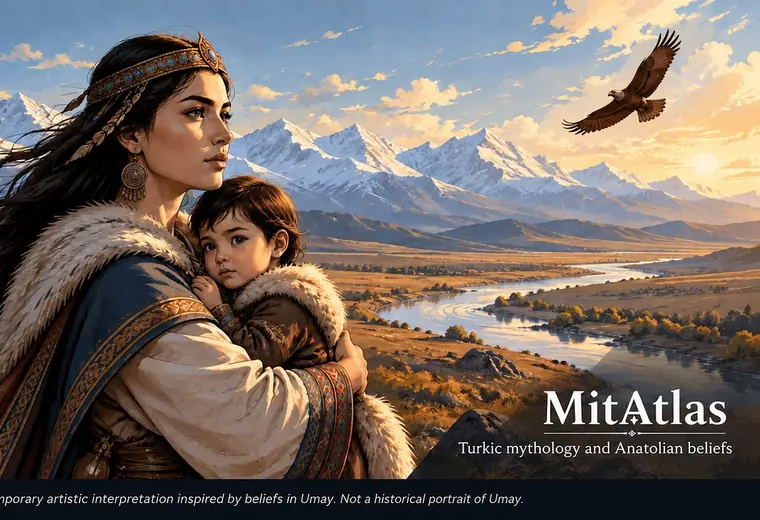
Modern illustrations give Umay particular faces, clothes, crowns, hairstyles and colours. Can we identify these as her historical appearance? Not securely on the evidence considered here.
Some historical depictions of women with three-lobed headdresses have been interpreted as Umay. Hayrettin İhsan Erkoç challenges treating that identification as certain, pointing out similar features in depictions of royal women. Labelling such an object simply “This is Umay” would therefore overstate the evidence.
The question is not whether artists may portray her. It is whether an artistic or disputed identification is being presented as verified historical fact.
8. What can we responsibly say?
The evidence falls into several groups:
- Early textual foundations: Umay is named in early Turkic inscriptions. The Kül Tigin inscription compares the ruler’s mother to her; Tonyukuk mentions her in a military context, with interpretive questions surrounding the passage.
- Later evidence: dictionaries and ethnographic records from different Turkic communities connect Umay with birth, childhood, motherhood and protection.
- Debated questions: the reading of Umay Beg and the identification of certain historical female images remain subjects of scholarly disagreement.
The original research did not verify that Umay was unambiguously Tengri’s wife, that all Turkic peoples shared one divine genealogy, or that they followed a common festival calendar dedicated to her. This is not a claim that no source could ever contain relevant evidence. It is a decision not to assert more than the evidence examined supports.
Sources and research transparency
The notes below describe the research behind the Turkish article, retained in this English adaptation.
- Sadettin Gömeç (1990), “Umay Meselesi,” Tarih İncelemeleri Dergisi, 5(1), 277–282. The study was examined directly for the Turkish article. Some information about the Dīwān and Yudakhin’s dictionary was used through Gömeç’s quotations; their relevant original entries had not been independently compared. Read the study.
- Hayrettin İhsan Erkoç (2024), “Gök Türklerde Doğa Kültleri,” Yazıt Kültür Bilimleri Dergisi, 4(2), 176–211. The Umay sections and images discussed in the study informed the original research. Read the study.
- Denis Sinor, translated into Turkish by Ahmet Taşağıl (1995), “Türkler Tarafından Şereflendirilen Bir Moğol Ruhu ‘Umay’,” Mimar Sinan Üniversitesi Fen-Edebiyat Fakültesi Dergisi, no. 2, 204–211. The Turkish publication was examined; the original foreign-language text had not been compared. The origin claim in its title is the author’s thesis, not a consensus asserted by MitAtlas. Publication record.
- Nükhet Okutan Davletov and Timur B. Davletov (2025), “Altın Köl I (E 28) Yazıtında Geçen Umay Beg İfadesi Üzerine,” bilig, 113, 79–100. Read the study.