Türkçe: Özgün makaleyi okuyun · English edition
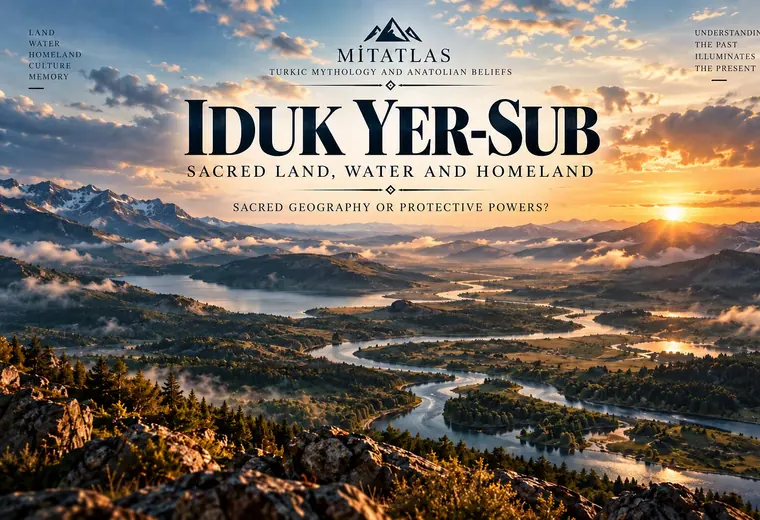
Iduk Yer-Sub is often described as “sacred land-and-water spirits,” protective powers or a sacred homeland. Early Turkic writing requires a more careful reading. We need to ask where ıduk, yer and sub occur, when the text was produced and which other terms appear beside them.
Later dictionaries, ethnographic records and scholarly interpretations add further layers. They are valuable, but not all are direct testimony to the eighth-century world of the inscriptions.
This English adaptation follows the Turkish MitAtlas article’s method: begin with the written evidence, then examine how Yer-Sub intersects with Tengri, Umay and qut. It asks what the historical sources support and where modern interpretation begins. “Turkic” denotes the wider historical and linguistic world, not just modern Turkey.
1. What does ıduk mean?
No single modern equivalent exhausts the historical word. In early Turkic writing, ıduk occurs in a field of sacredness or special status. Expressions such as ıduk yer-sub and ıduk Ötüken show that it can qualify places and geography. [S1]
Iduk and Yer-Sub are not the same thing: one functions as a qualification, while the other is an expression requiring its own contextual explanation. Treating “Iduk Yer-Sub” as a modern personal name can hide those distinctions.
Later linguistic evidence makes context still more important. In the tradition of the Dīwān Lughāt al-Turk, ıduk is associated with things considered blessed or sacred, and a specific use for a dedicated animal is recorded. [S4] That eleventh-century explanation cannot automatically define every eighth-century occurrence.
The continued existence of a word does not prove an unchanged function or setting. A dictionary offers a starting point, not a complete interpretation of a particular inscription. For that, we must read the sentence, its neighbouring concepts and its historical purpose.
2. Three inscriptions, three contexts
Kül Tigin, Tonyukuk and Bilge Qaghan provide complementary but distinct evidence. Terms occurring together are important clues; they do not automatically establish a fixed pantheon or a complete theological hierarchy.
Kül Tigin: Tengri and Iduk Yer-Sub
Around line 10 on the east face of the Kül Tigin inscription, Tengri and Iduk Yer-Sub occur within the same narrative setting. [S1] This is evidence for the expression in early Turkic writing. It is not, by itself, a statement that “Tengri and Yer-Su were two gods in a defined pantheon.” That formulation would add a system the passage does not spell out.
Tonyukuk: Tengri, Umay and Iduk Yer-Sub
Around line 38 of the Tonyukuk inscription, Tengri, Umay and Iduk Yer-Sub appear together. [S2] This is an important reason not to study Yer-Sub in isolation.
Modern translations can differ, including over the following verb. We therefore distinguish the attested combination of terms from the interpretation supplied by any single translation.
Bilge Qaghan: Tengri, Iduk Yer-Sub and qut
Around line 35 on the east face of the Bilge Qaghan inscription, Tengri, Iduk Yer-Sub and qut appear within the same narrative environment. [S3] Vocabulary associated with the sky, sacred geography and rulership can thus intersect in the same textual world. Co-occurrence does not reveal every aspect of their relationship.
| Textual setting | Terms considered together in the Turkish research | Evidential limit |
|---|---|---|
| Kül Tigin, east face, around line 10 | Tengri; Iduk Yer-Sub | Does not define a complete pantheon |
| Tonyukuk, around line 38 | Tengri; Umay; Iduk Yer-Sub | Translation and interpretation require comparison |
| Bilge Qaghan, east face, around line 35 | Tengri; Iduk Yer-Sub; qut | Does not establish an unchanging hierarchy |
This table conveys the central information of the Turkish infographic without reproducing its Turkish lettering. To go further, we need syntax, the text’s purpose, alternative readings and the wider historical setting—not just a list of adjacent words.
3. Ötüken and sacred geography
Ötüken is an important historical place-name at the intersection of geography and political order. The expression ıduk Ötüken is particularly relevant: it shows that the qualifier is not confined to Yer-Sub. [S1]
Ötüken should not simply be equated with Iduk Yer-Sub. It names a particular historical geography; ıduk qualifies it. Yer-Sub belongs to a wider field of usage and interpretation.
Rather than writing “Ötüken = Yer-Su,” we can investigate how early texts bring place and sacredness together. The expression supports that question without collapsing the terms into one another.
4. Two approaches to reading Yer-Su
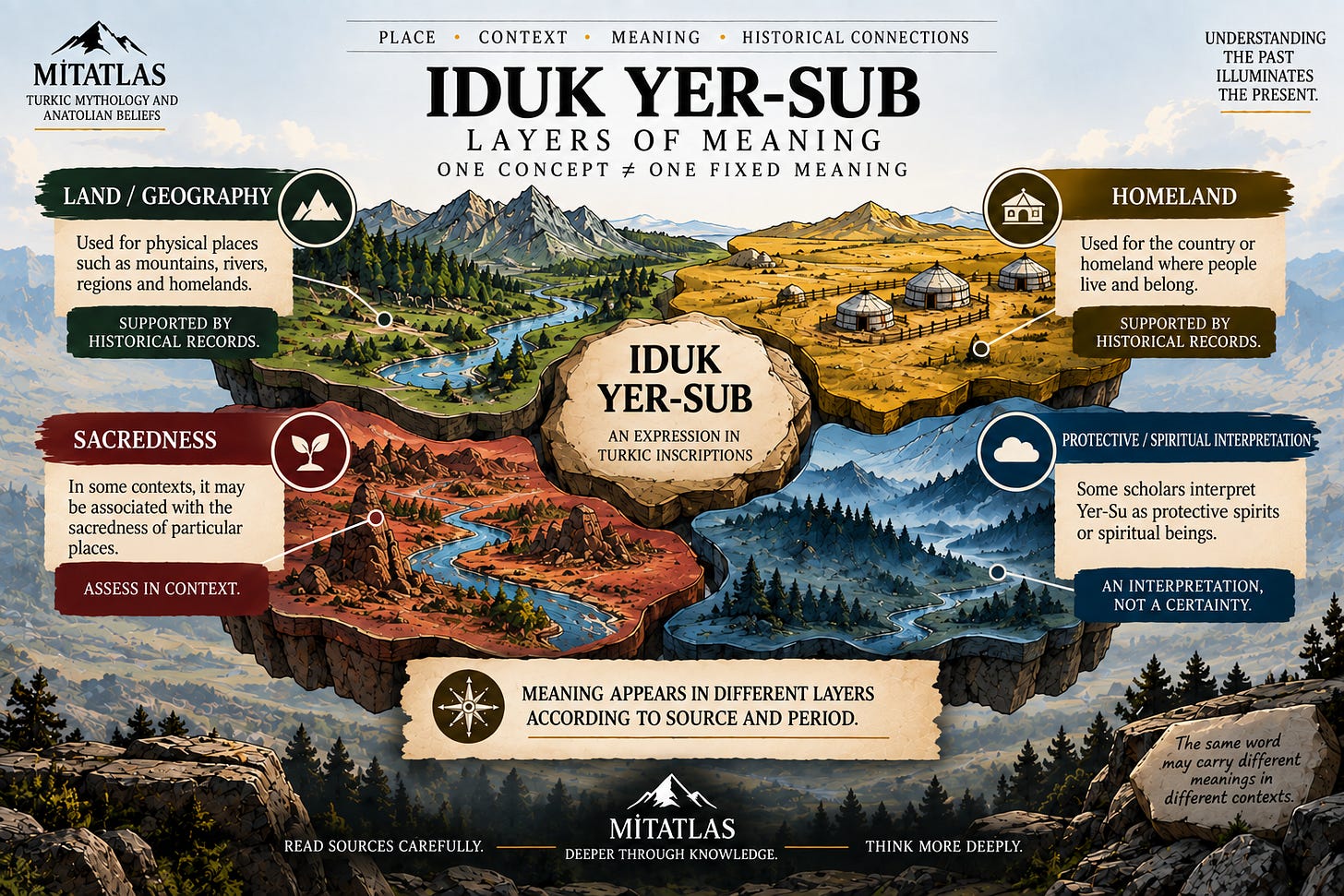
Modern scholarship does not offer one uniform explanation. One approach begins with language and textual usage. Historical Turkic evidence shows yer-sub / yer-suv in semantic fields including land, earth, world, country and homeland. [S5] This makes it unsafe to translate every occurrence automatically as “spirits.”
Another approach develops through religious history, mythology and ethnographic interpretation. Some researchers understand especially ıduk Yer-Sub in terms of protective or spiritual powers associated with sacred geography. [S6]
In a line of interpretation associated with Abdülkadir İnan, these approaches need not exclude each other: geography or homeland and its protective powers may be read in relation to one another. [S7] This is an academic interpretation, not a dictionary definition dictated by the inscription.
The presence of a “Yer-Sub spirits” explanation in scholarship does not make every historical usage mean only spirits. Geographic usages do not automatically invalidate every sacred or spiritual reading either.
The cautious conclusion is that geographic meanings are part of the expression’s historical range, while protective-power readings form an important debate about particular contexts.
5. Layers of meaning across periods
The combination yer-sub / yer-suv, the sacred qualification ıduk, and interpretations involving protective powers should be considered separately before being brought together. [S5–S6] Their coexistence does not mean all are equally prominent in every text. Source, period and context determine the emphasis.
Old Uyghur and later evidence
The history of ıduk does not end with the Orkhon inscriptions. Later Turkic texts retain usages associated with sacredness. They allow comparison and investigation of possible continuity, but cannot prove that an eighth-century passage had precisely the same meaning.
What the Dīwān adds
Academic discussions of the eleventh-century dictionary connect ıduk with blessed or sacred things and record a special use for a dedicated animal. [S4] This both extends the documented history of its sacred associations and shows that its usage is not confined to one object or conceptual setting.
The centuries between the sources matter. An eleventh-century dictionary entry is not an automatic gloss on an eighth-century inscription.
6. Match the source to the question
Different sources answer different questions:
- Early inscriptions show which words are actually present in particular historical texts.
- Later dictionaries and linguistic records help compare subsequent meanings.
- Modern scholarship offers analyses of language, history, religion and culture.
- Later ethnography and popular-belief records describe later communities and practices, rather than directly documenting the eighth century.
One category is not simply “better” than every other. If we ask what an eighth-century inscription says, the inscription is central. If we ask how a word was explained in the eleventh century, the dictionary becomes necessary. If we ask why researchers disagree, we need to compare their studies.
The aim is to connect the right evidence with the right question. For a term surrounded by confident modern stories, establishing what we cannot yet know can be as useful as identifying what we do know.
7. Evidence and open questions
Several conclusions are supported. Iduk Yer-Sub is present in early Turkic writing, with Kül Tigin, Tonyukuk and Bilge Qaghan providing significant attestations. [S1–S3] Philological work identifies geographic and homeland-related uses of Yer-Sub. [S5] Early and later evidence allows investigation of the sacred semantic field of ıduk. [S1, S4] Different passages place the expression beside Tengri, Umay or qut.
Other questions remain unanswered by those records alone. The inscriptions do not provide a detailed physical portrait of Yer-Sub. They cannot verify a particular modern human, divine or spirit figure as its historical appearance. Nor do the terms’ combinations establish a complete, fixed pantheon hierarchy.
The precise shape of rituals, the existence of an organized structure and the extent to which communities shared practices cannot be settled from the Orkhon inscriptions alone. Later ethnography can contribute, but its historical distance must be made explicit. [S8]
An apparently complete story can be constructed by combining later records, modern art and practices from different communities. Its coherence does not make it historically demonstrated. When a source is silent, a modern narrator’s voice must not be substituted for its testimony.
8. Modern stories and the limits of the record
Claims that Yer-Su had one definite appearance, an established universal symbol, a fixed place in a pantheon or identical rituals among all Turkic peoples require specific supporting evidence.
To assess a claim, first identify its source. Then identify that source’s date and type. Finally, separate what it records from what later interpreters infer.
The inscriptional occurrence of Iduk Yer-Sub is a historical attestation. A claim about its physical appearance needs additional testimony. The same applies to ritual reconstructions and symbols. Later ethnography can be valuable without becoming direct eighth-century evidence. [S8]
Source checking does not reject compelling stories merely because they are compelling. It identifies which parts are historical records and which are later interpretations.
9. A practical reading method
- Find the attestation. Which inscription, text or dictionary actually contains the expression? Its appearance in a modern book does not prove an identical early occurrence.
- Read the context. Keep the word within its sentence. What does the passage describe, and what other concepts accompany it?
- Separate the periods. Eighth-century inscriptions, an eleventh-century dictionary, modern scholarship and later field records belong to different layers.
- Distinguish interpretation from evidence. A researcher’s explanation can be valuable without being identical to what the ancient wording explicitly states.
This sequence—source, context, interpretation—also guides MitAtlas’s articles on Tengri, Umay and qut. It yields a map of evidence rather than an oversimplified definition.
10. Sacred geography or protective powers?
The evidence does not compel us to choose only one of these labels. Geographic and homeland meanings are prominent in historical linguistic usage. The qualifier ıduk and the scholarly tradition of interpretation also make sacredness and protection relevant to the investigation.
Iduk Yer-Sub can cautiously be approached as an expression where sacredness intersects with land, homeland and geography in the early Turkic world. That does not prove it meant only physical terrain; neither does it establish a fully known system of spirits or gods.
Exact appearance, universal symbols, a complete theological hierarchy and supposedly uniform rituals should remain open questions where the evidence is insufficient. Sources provide a framework; they do not fill every gap.
Reading the interconnected articles reveals how these terms meet in the same historical texts. The method remains the same: read the source accurately, preserve its context and separate interpretation from evidence.
11. Sources and access notes
The numbering preserves the Turkish article’s source structure. Some links are studies or textual discussions rather than editions of the original monument; their roles are stated accordingly. This adaptation does not claim a new independent inspection of every primary source.
- S1 — Orkhon inscriptions: Kül Tigin and the Ötüken context. Used for ıduk yer-sub and ıduk Ötüken, distinguishing original-language wording from modern Turkish translation. The linked study is hosted by the Atatürk Culture, Language and History Higher Institution.
- S2 — Tonyukuk textual and word analysis. Used for the combination of Tengri, Umay and Iduk Yer-Sub around line 38. Alternative translations of the following verb were not treated as one uncontested reading.
- S3 — Academic discussion of Bilge Qaghan. Used for the terms’ conjunction around east-face line 35, without treating co-occurrence as proof of a complete theology.
- S4 — Study concerning the Dīwān Lughāt al-Turk. Used to compare sacred/blessed and dedicated-animal usages of ıduk, preserving the chronological distance from the inscriptions.
- S5 — Emriye Sonkaya (2024), Eski Türkçede “yer-su” adları ve kavram alanı. Philological research on Köktürk, Old Uyghur and Karakhanid material and the meanings of yér sub / yér suv, including earth, world and homeland. Its linguistic evidence is distinguished from religious-historical interpretation.
- S6 — Academic interpretations of Yer-Su as sacred or protective powers. Used to document a scholarly approach, not a direct inscriptional definition.
- S7 — Abdülkadir İnan and the Yer-Su interpretation tradition in Turkic religious history. Used for the relationship between homeland/geography and protective powers, identified as researcher interpretation.
- S8 — Later Yer-Su, nature and popular-belief records. Comparative material concerning later communities, not direct testimony to eighth-century Orkhon practices. The original links include Eski Türk Topluluklarında Yer-Su İnancının Destan ve Hikâyelere Yansımaları and Eski Türk Kitabelerindeki Yer-Sub Meselesi.
The TDV İslâm Ansiklopedisi entry “Orhon Yazıtları” supplies general historical context. Academic links may move over time; the source description and its use are therefore retained alongside the links below.
Source links retained from the Turkish article
- S1: linked study hosted by AYK
- S2: Tonyukuk textual discussion
- S3: linked academic study
- S4: study concerning the Dīwān
- S5: Sonkaya, Marmara University record
- S6: linked religious-historical study
- S7: linked interpretation study
- S8: Aperta record
- S8: Yer-Sub discussion
- General context: Orhon Yazıtları