Türkçe: Özgün makaleyi okuyun · English edition
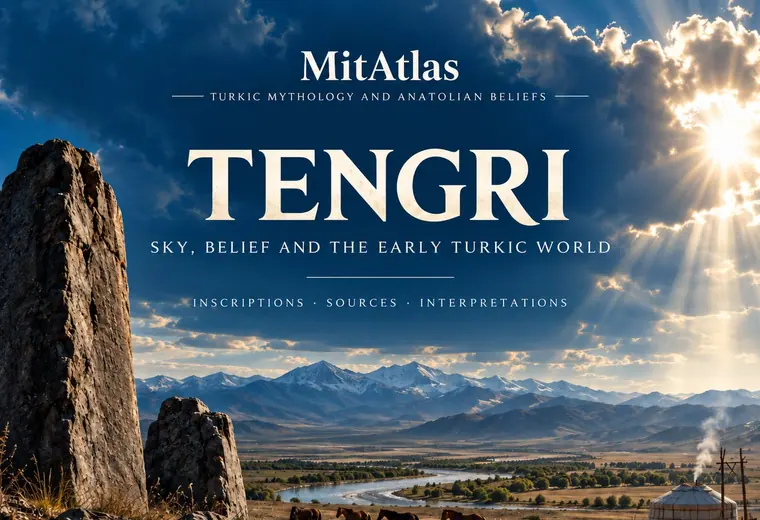
Let us look for Tengri first in a word, rather than a face. Our evidence includes something more valuable than an imagined portrait: Turkic texts carved in stone about thirteen centuries ago.
Old Turkic teŋri does not convey exactly the same thing in every passage. It can occur in a sentence about the sky and also act within narratives of rulership, success and sacred will. We therefore begin with sources and contexts, not a modern list of gods.
This English adaptation follows MitAtlas’s Turkish article through the Kül Tigin, Bilge Qaghan and Tonyukuk inscriptions, Chinese records and Byzantine testimony. It preserves the original distinctions between direct attestation, scholarly interpretation and uncertainty. “Turkic” refers to the broader historical and linguistic world, rather than only modern Turkey.
1. Where should we look for Tengri?
The evidence for early Turkic mythology is dispersed among sources from different periods and communities. We do not possess a single ancient book collecting every deity, genealogy and story into one complete system.
For Tengri, a major advantage is the survival of early Turkic writing in its own language. The Kül Tigin, Bilge Qaghan and Tonyukuk inscriptions describe more than wars and rulers. They also preserve ideas about the il—the political realm—budun, the people or community, qaghanate, success, failure and sacred order.
Chinese and Byzantine records add perspectives from societies that encountered the Turks. The inscriptions speak from a ruling milieu within the Turkic world; Chinese writers interpret another culture through their own vocabulary; Byzantine testimony records encounters from a different political and cultural setting.
For any claim, we ask: who says it, when, and about whom? Is it direct observation or a transmitted account? What other evidence supports it? These questions place Tengri within a historical world rather than turning the figure into a single character assembled by modern imagination.
2. What does teŋri mean?
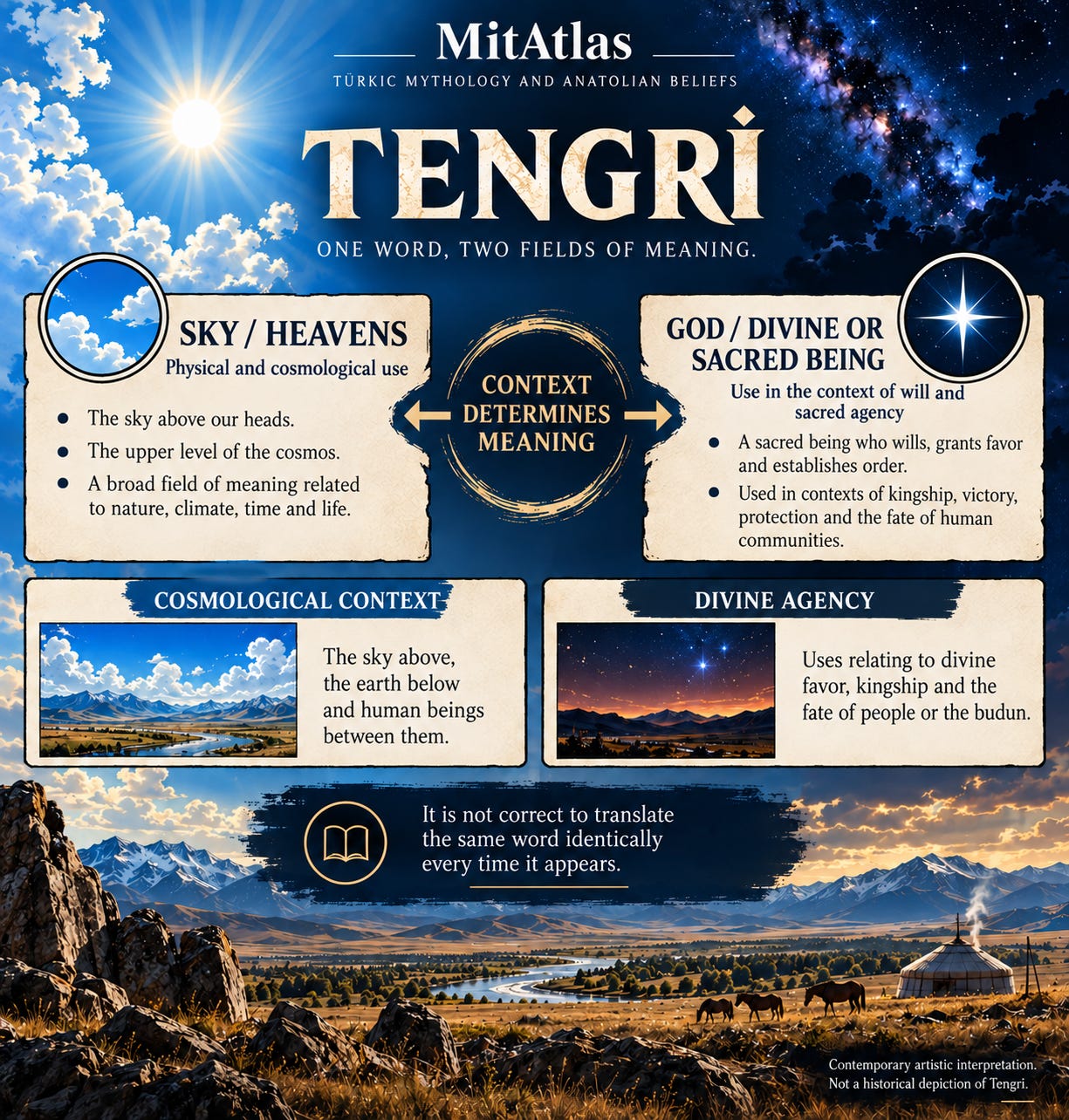
The word’s importance lies partly in its range. Old Turkic texts contain usages associated with sky or heaven and usages in a divine or sacred field.
We cannot assume that every occurrence describes a personified deity. Nor can every occurrence be reduced to the physical sky. Context determines which interpretation is plausible.
3. Sky or deity?
The cosmological opening of the Kül Tigin inscription includes üze kök teŋri. The sentence presents the sky above, the earth below and humanity between them. That is a celestial and cosmological setting.
Elsewhere in the inscriptional world, Tengri appears in contexts of rulership, favour and success in ways that can be read as the action of a sacred agent. The cosmological passage demonstrates a sky-related usage; it does not prove that the word always means only the physical sky.
This apparently small distinction affects every larger account we construct.
4. Tengri carved in stone
The monuments of Kül Tigin and Bilge Qaghan stand around Khöshöö Tsaidam in the Orkhon region. Tonyukuk’s monument complex is not at the same location. The conventional grouping of these foundational texts should not make us imagine all their stones standing together.
Nor should the inscriptions be read as a mythology handbook. Their purpose was not to supply divine biographies. Tengri appears while the texts describe war, rulership, the people’s condition and political order. Each occurrence needs to be understood within that purpose.
5. Sky, earth and humanity
The opening of Kül Tigin offers a powerful cosmological arrangement: sky above, earth below, people between. A few lines, however, cannot justify reconstructing a complete creation myth or attributing every later creation story to the Göktürk inscriptions.
Other sacred elements also matter. Sacred Yer-Su, or Yer-Sub, appears in the textual world. Tengri’s centrality does not establish that Tengri was its only sacred being or power. Umay and Yer-Sub complicate any overly simple account.
6. Tengri and the qaghan
The inscriptions connect Tengri strongly with rulership, but we should not replace their wording with a modern formula such as “the qaghan was Tengri’s earthly representative.”
Tengri’s yarlıkama occurs when rulership, political success and the course of events are explained. The associated verb should not be reduced to the everyday modern Turkish sense of merely giving permission. In these contexts it can involve effective sacred will, favour or approval.
Its importance to rulership does not establish that every decision made by a qaghan was automatically a divine command.
7. Qut and sacred legitimacy
Popular accounts often offer a simple chain: Tengri → qut → qaghan. The evidence is less mechanical. Tengri’s favour and qut can be considered together in royal contexts, but that does not make qut exclusively a mystical governing energy handed to a ruler.
Depending on context, qut is discussed in relation to fortune, felicity, sacredness and rulership. Tengri’s favour and qut are not identical concepts.
Consider the claim that anyone receiving qut automatically becomes qaghan. The evidence permits a relationship between these concepts in the inscriptions; it does not supply that universal mechanism. MitAtlas’s separate qut article examines the broader historical range.
8. War, fortune and the Turkic people
Tengri’s role extends beyond the ruler as an individual. The texts repeatedly connect qaghan, political realm, people, war, success and defeat. The ruler’s performance, the realm’s condition and the people’s survival can be understood together.
Reading Tengri only as a personal deity answering individual wishes would miss that political scale.
Does Tengri bring only victory? No: failure can also be interpreted within sacred order. Chinese records include accounts in which Göktürk rulers understand defeats or extraordinary events through Tengri’s will or anger.
“War god” or “the being who always gives the Turks victory” is therefore too narrow. Tengri appears in how rulership, success, failure and the political world are understood.
9. Umay, Yer-Su and other sacred elements
Tengri’s prominence does not exclude other sacred beings or powers. In Kül Tigin, Bilge Qaghan compares his mother to Umay. Readings of Tonyukuk also bring Umay and sacred Yer-Su into discussions of warfare and assistance.
Researchers can disagree over the segmentation and interpretation of particular wording. The terms’ occurrence does not deliver an unchanging list of Göktürk gods with all their relationships defined.
Were Tengri and Umay married? Their relationship has been debated in scholarship. The sources used here do not justify an uncontested divine-marriage scheme applicable to the whole Göktürk world. We therefore do not present “Umay was certainly Tengri’s wife” as established fact.
10. How was Tengri worshipped?
Online reconstructions of a “Tengri ceremony” may contain drums, horned headgear, magical circles, statues and symbols. We cannot treat all these as verified elements of a seventh-century Göktürk ritual.
The Byzantine account
Theophylact Simocatta provides external testimony concerning Turkic beliefs. His account includes respect for fire, sacred associations of air and water, the significance of earth, and worship of a deity who created heaven and earth. It also mentions offerings of horses, cattle and sheep and people associated with divination.
This is not a ritual manual written by a Göktürk participant. Its outsider perspective must remain part of how we use it.
Fire purification and Zemarchus
The narrative of the Byzantine embassy of 568 includes an account of fire purification involving the envoy Zemarchus and his belongings. That episode and Theophylact’s discussion of offerings and sacred elements are not two stages of one documented ceremony.
| Recorded elements discussed in the sources | Details completed by artistic reconstruction |
|---|---|
| Accounts of animal offerings | Exact clothing and appearance |
| Respect for fire or purification involving it | The precise arrangement of the setting |
| Sacred associations of natural elements | Tent locations and the number of participants |
| Testimony about worship of a creator deity | The reconstructed landscape |
| Persons associated with divination | Other visual details not specified in the account |
This distinction carries the central information of the Turkish ritual infographic into English without reproducing its Turkish labels.
What about shamans?
Mentioning divination or ritual specialists is not enough to establish that “shaman” was the official title of every Göktürk religious practitioner. Kam traditions, shamanism and later Turkic-Siberian evidence require a separate investigation. They should not be inserted as a ready-made explanation for every early ritual.
11. What do Chinese records tell us?
Chinese dynastic histories and other records contain information about Göktürk politics, life and belief. They are not the Turks describing their own concepts in their own words.
Rendering Teŋri through terminology such as Tian or Tianshen does not demonstrate that the two cultures’ theological concepts were identical. The terminology itself is part of the interpretive problem.
Accounts connecting failures or extraordinary events with Tengri’s will or anger reinforce the point that the sacred framework was not limited to victory. Success and failure could both be given meaning within it.
12. What did Byzantine observers see?
Each source type opens a different window. Turkic inscriptions name Tengri directly in relation to rulership, favour and political order and also mention other sacred elements. Chinese records view the Turkic world from outside, filtering concepts through their writers’ language. Byzantine testimony contributes accounts of worship, offerings, sacred natural elements and fire purification.
These records do not all describe the same event or answer the same question. They can complement one another while retaining different perspectives. A royal monument, a court historian and a Byzantine narrative have different purposes. Their differences are useful evidence, not defects to erase.
13. Do we know Tengri’s face or symbol?
Modern images portray Tengri as an elderly bearded man, a steppe ruler or a celestial warrior. Popularity does not make an image historical evidence.
The inscriptions do not provide a reliable physical description from which we can reconstruct Tengri’s face, hair, clothing or body. The Turkish MitAtlas cover therefore uses sky, steppe, mountains and light without claiming to depict a verified body or face.
Symbols require the same caution. Some modern signs resemble historical Turkic tamgas; others belong to contemporary Tengrism. The research behind this article did not verify a single sign as the definite, universal Göktürk symbol or flag of Tengri.
“Not verified” does not mean “proved never to have existed.” It states a limit of the evidence examined.
14. Are Tengrism and shamanism the same?
The equation “Tengrism = shamanism” is too simple for the historical material. Modern writers use labels such as Tengrism, traditional Turkic religion and the cult of Tengri in different ways. We cannot assume that eighth-century Göktürks officially named their religion with today’s term.
Shamanism is also a wider comparative field involving such matters as trance, relations with spirits, healing, divination and ritual specialists across northern and Inner Asian societies. Its relevance to comparison does not make every Göktürk specialist automatically a shaman.
Contemporary Tengrism includes living religious, cultural and identity movements. These may draw inspiration from old Turkic sources. They are not thereby demonstrated to reproduce eighth-century belief unchanged.
Modern Tengrism deserves study in its own setting. Historical Göktürk belief is investigated through inscriptions, archaeology and contemporary external testimony. The subjects can be compared without being equated.
15. What is known, and what remains debated?
The name Tengri occurs directly in early Turkic inscriptions. The word has sky-related and divine or sacred usages. It appears in royal and favour-related contexts; Umay and sacred Yer-Su are also present. Byzantine testimony records offerings and aspects of ritual and sacred nature.
Other questions remain interpretive: how to assess creative power across different sources, how modern categories such as monotheism apply, the relationship with Umay, the layers of qut, and the relationship between Tengrism and shamanism.
Tengri’s centrality is clear, but Umay, Yer-Su and other sacred elements make theological classification an academic interpretation rather than an uncontested self-description supplied by the sources.
What about human sacrifice?
Records and scholarly debate concerning human sacrifice exist. A recorded claim does not establish a regular, universal practice across the Göktürk world. Xiongnu/Hun, High Cart, Göktürk, Uyghur and later Turkic communities are not one interchangeable historical society. The scope and generalizability of such evidence remain disputed.
Claims we do not present as settled history
- One verified human portrait of Tengri.
- One definite historical symbol or flag applicable everywhere.
- Tengri and Umay as an unquestionably married couple among all Turkic peoples.
- One unchanging pantheon shared by every community.
- One standard ritual performed in every period.
- Modern Tengrism as an unchanged copy of Göktürk belief.
Conclusion: do not make the source say more than it does
The evidence is valuable precisely when its origins and limits remain visible. We can identify strong attestations without pretending that every question has the same level of certainty. Historical understanding improves when gaps remain questions instead of becoming invented facts.
Related MitAtlas studies examine Umay, qut and Iduk Yer-Sub. Kam traditions and shamanism remain a subject for a separate research article.
Sources and research transparency
This adaptation preserves the source categories of the Turkish article; it does not claim that all original works were newly inspected for the English version.
Primary sources and foundational editions: the Kül Tigin, Bilge Qaghan and Tonyukuk inscriptions; Talât Tekin’s Orhon Yazıtları: Kül Tigin, Bilge Kağan, Tunyukuk; Theophylact Simocatta’s external testimony; Byzantine narratives of Zemarchus’s 568 embassy; Chinese dynastic histories and chronicles. These sources have different authors, purposes and perspectives.
Modern scholarship:
- Hayrettin İhsan Erkoç (2026), “Gök Türklerde Teŋri Kültü,” ASSOS İnsan ve Toplum Bilimlerinde Araştırmalar Dergisi, 3(2), 32–61. Study.
- Yeşim Çağlar and Sevda Kuru (2025), “Eski Türkçede Teŋri Sözcüğü Üzerine,” Akademik Dil ve Edebiyat Dergisi, 9(2), 1366–1391. DOI: 10.34083/akaded.1702561. Study.
- Hayrettin İhsan Erkoç (2024), study of nature cults among the Göktürks, used for sacred natural elements considered alongside Tengri.
- Specialist scholarship on Yer-Su, Umay, qut and alternative readings of Old Turkic inscriptions, used comparatively in the Turkish article’s discussion of disputed points.
Material from Xiongnu/Hun, Uyghur, later Turkic and Siberian traditions is comparative evidence, not direct proof for the Göktürk period. Source date, context, authorship and transmission matter. Disputed interpretations remain disputed, and contemporary artistic reconstructions are not historical photographs or archaeological proof.