Contents
- Who Is Erlik?
- Erlik’s Story: From Creation to His Fall
- Erlik’s Own World
- Eezi: Owners of Mountains, Waters and Forests
- Is Erlik Really a “God of the Underworld”?
- Erlik and Kam Ritual
- Erlik and the End of the World
- How Old Are the Erlik Narratives? Sources and Missionary Influence
- Is There One “True Legend of Erlik”?
- Conclusion: How Should We Describe Erlik?
- Principal Russian Sources Translated and Compared for the Turkish Edition
- Other Early and Supporting Sources
- A Final Note on the Use of Sources
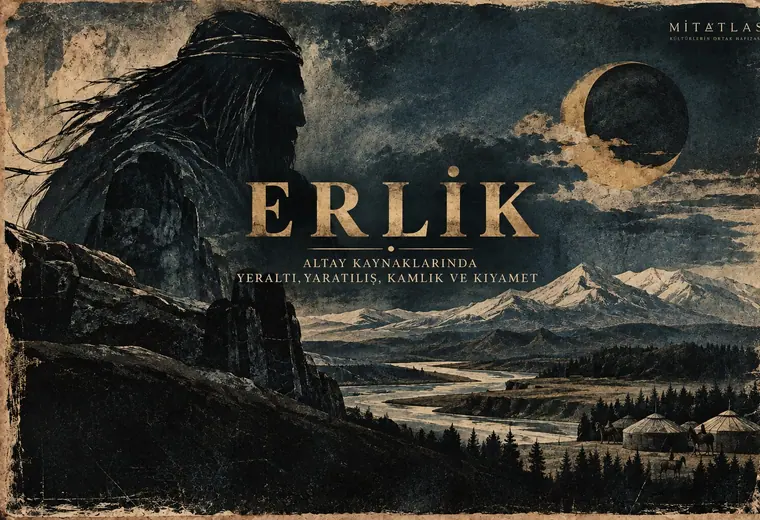
In popular writing about Turkic mythology, Erlik is often introduced in a few words: ruler of the underworld, lord of death, embodiment of evil, or the dark power opposed to Ülgen.
These descriptions are not entirely without foundation. Yet a careful reading of narratives recorded in the Altai in the nineteenth century reveals a much more complex figure.
In some accounts, Erlik is not an unchanging “devil” who has inhabited the underworld from the beginning. He first appears as a created being close to Ülgen. He then becomes his rival, intervenes in the creation of human beings, establishes a world of his own, forges servants, fights Mangdı-Şire, and is eventually cast into the lower world.
Nor does the story end there. The servants who fall from the sky with Erlik are said to become the eezi—the “owners” or “owner-spirits”—of waters, mountains, stones, forests and houses. Another narrative presents Erlik as the first teacher of kam ritual. At the end of the world, he rises to the earth again and enters a final cosmic conflict with Ülgen’s forces.
To describe Erlik only as “the devil of Turkic mythology” therefore obscures a substantial part of the historical material.
There is, however, a second question: which narrative about Erlik are we discussing?
The nineteenth-century texts available to us are not independent copies of a single, unchanging legend. Some draw on earlier manuscripts; others reuse previously published material. Editors combine passages, while Christian missionary terminology appears alongside local Altai elements.
This article therefore examines not only Erlik’s story, but also how the stories about Erlik have reached us.
Who Is Erlik?
In Altai narratives, Erlik is one of the principal figures opposed to Ülgen. In some creation variants, however, that opposition is not present from the outset.
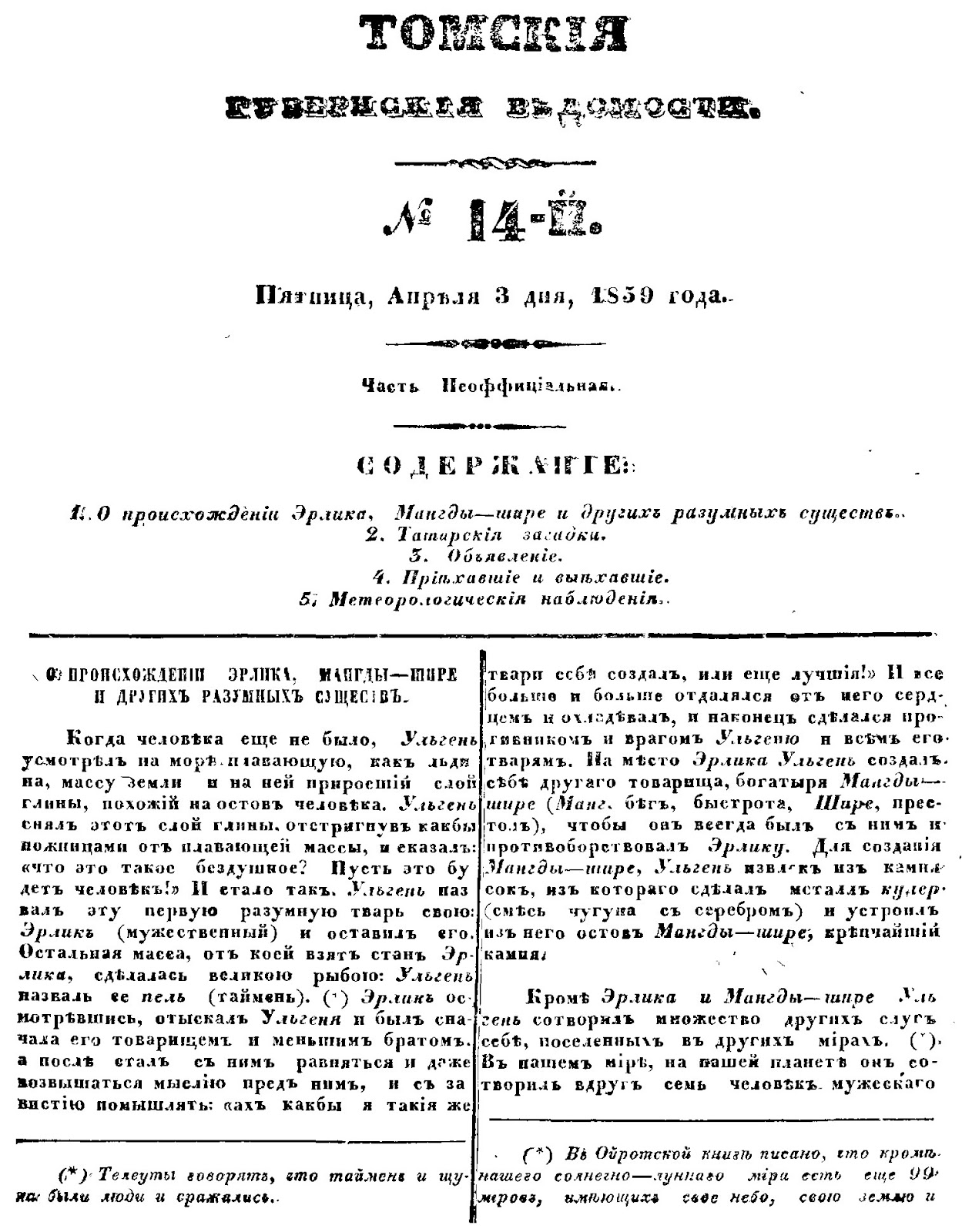
In the group of narratives published by Verbitskiy, before human beings have appeared, Ülgen sees a mass of earth or clay floating on the sea. An intelligent being comes into existence from this material and is named Erlik.
As the narrative develops, Erlik is a figure close to Ülgen. There is a small but important difference between the sources here. The version published under Landyshev’s name in 1886 describes Erlik as being close to Ülgen “like his own brother,” whereas the 1893 Altayskie inorodtsy explicitly calls him Ülgen’s “younger brother.”
This distinction matters. Erlik does not appear here as Ülgen’s eternal enemy from the beginning. He is initially close to him. Later, he starts comparing himself with Ülgen and imagining that he can create beings like Ülgen’s—or even better ones. Rivalry gradually becomes open opposition.
Ülgen, in turn, creates a new champion to take Erlik’s place: Mangdı-Şire. The struggle between Erlik and Mangdı-Şire becomes one of the narrative’s central threads.
Source note: Erlik’s animation and his initial relationship with Ülgen are not described in exactly the same way in the 1886 and 1893 versions. The 1886 text includes the detail of his being brought to life by a breath blown into his ear; the 1893 version omits it.
Erlik’s Story: From Creation to His Fall
Was Erlik “Evil” from the Beginning?
Modern retellings often introduce Erlik simply as a “god of evil.” Some historical Altai variants, however, give the story a different structure.
Erlik’s dark position is not an unalterable quality assigned to him at the beginning, but the outcome of a conflict that develops within the narrative. First he is close to Ülgen; then he tries to demonstrate his own creative power. His wish to equal Ülgen becomes rivalry, and that rivalry eventually develops into a struggle between two cosmic orders.
In some nineteenth-century Altai variants, Erlik is portrayed not as an unchanging principle of evil from the outset, but as a figure initially close to Ülgen who gradually turns against him.
Maidere, the Creation of Woman, and Erlik’s Intervention
Erlik’s involvement in the human world becomes more pronounced in the creation narratives. The formation of a human body from clay and reeds, Maidere, the creation of woman, and a dog left on guard are connected in this part of the story.
In Maidere’s absence, Erlik approaches the still-unfinished woman and intervenes in bringing her to life. The dog also plays an important role. Erlik is said to promise it a warm coat of fur, coverings to protect its feet, and food. The dog’s subsequent fur, claws and habit of feeding on scraps are explained through this episode.
Another creation of woman follows. This time, Ülgen is said to form a new woman from pieces taken from Targın-Nama’s ribs.
The parallels with Christian creation narratives are particularly clear: a woman made from a rib, deception, transgression and subsequent exile. Yet the text as a whole is not simply a copy of Genesis. Erlik, Maidere, Mangdı-Şire, the dog’s distinctive role and local cosmological elements cannot be reduced directly to the Christian narrative pattern.
Erlik’s Exile
As a result of his conflict with Ülgen, Erlik is banished to a dark region. In some variants, this is a land between two seas, beyond the reach of sunlight and moonlight.
Exile does not end Erlik’s relationship with human beings. He returns to the world they inhabit and attempts to claim authority over their souls. Through episodes involving fruit, deception and transgression, he intervenes in human life again.
This section, too, has clear similarities to Christian narratives of the Fall. Not every element of the plot, however, corresponds directly to that pattern.
Erlik’s Own World
The story after Erlik’s exile shows that he is not merely a punished, passive figure. According to the narrative, he establishes a sky and an earth of his own within his domain.
This is a significant detail. Erlik is not only a power that damages Ülgen’s world: he presides over an alternative order and seeks to create a cosmic domain of his own.
Erlik and Blacksmithing
When the servants in this new world cannot multiply, Erlik makes himself a hammer, an anvil, bellows, tongs and other smithing tools. He heats the iron and begins to strike it. According to the account, each blow of his hammer brings a kürümes into existence. In this way, he creates numerous beings to serve him.
This scene considerably broadens Erlik’s role. Here he is associated not only with death and the underworld: he produces, shapes and establishes an order of his own.
It does not follow, however, that “Erlik is the blacksmith god of Turkic mythology” is a conclusion applicable to all Turkic cultures. This motif belongs to particular Altai narrative variants.
The Cosmic Battle of Erlik and Mangdı-Şire
Ülgen’s champion Mangdı-Şire goes to the world Erlik has established. He sees that Erlik has created beings there and tries to stop him. Erlik responds by sending two powerful servants against him: Kerey-Han and Karaş.
Mangdı-Şire is unsuccessful in the first battle and returns to Ülgen. This time, Ülgen sends him back with his own command and power. In the second battle, Mangdı-Şire first defeats Kerey-Han and then Karaş. Finally, Erlik himself confronts him.
Mangdı-Şire strikes Erlik in the right shoulder; the weapon is said to pass through his body and emerge at his left hip. Erlik is hurled down, and the order he has built collapses.
Eezi: Owners of Mountains, Waters and Forests
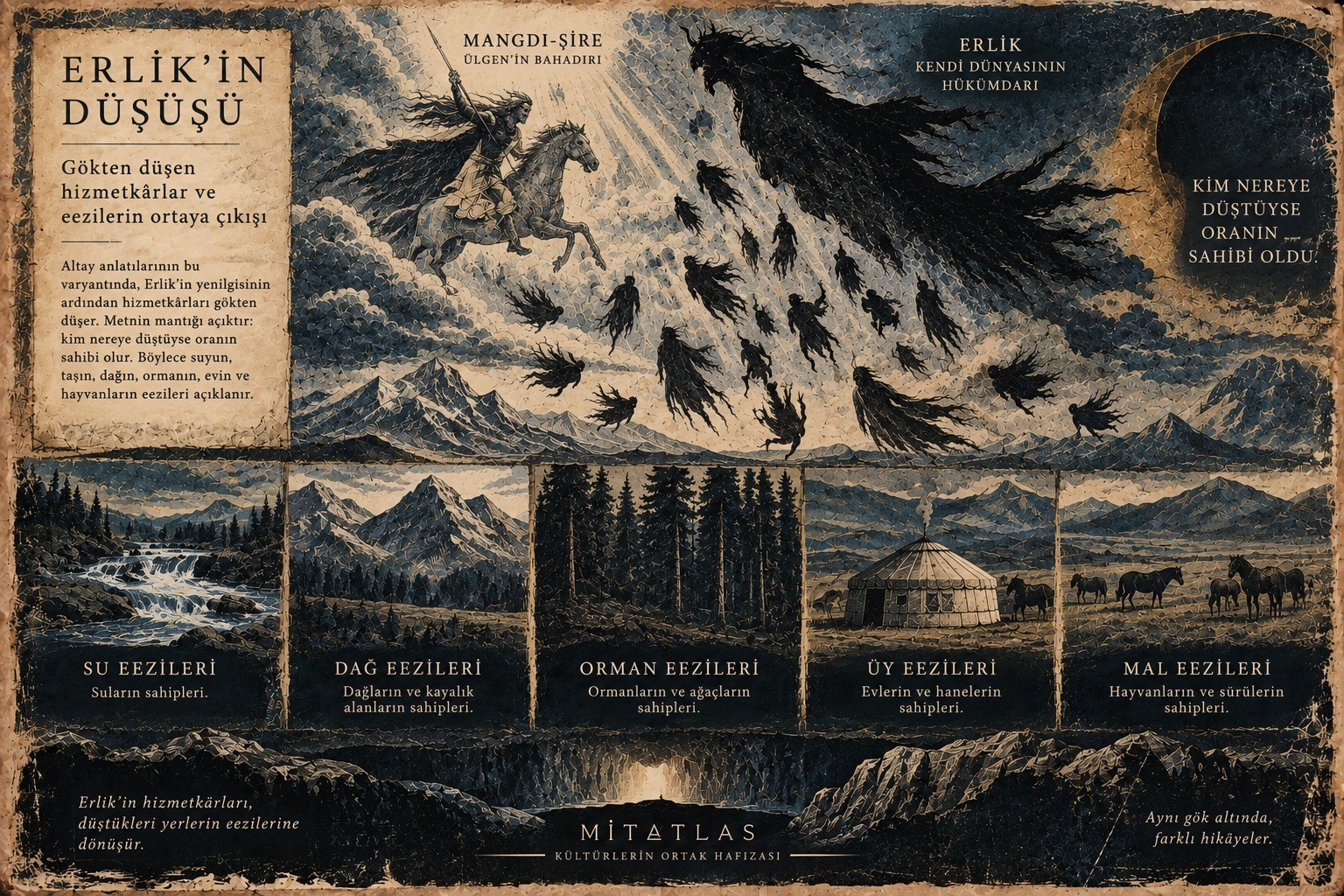
Erlik’s servants fall from the sky after him “like hail and rain.” Each lands in a different place.
- The one who falls into water becomes its owner.
- The one who falls onto a stone becomes its owner.
- The one who falls onto a mountain becomes its owner.
- The one who falls into a forest becomes its owner.
- The one who falls into a house becomes its owner.
- The one who falls upon animals becomes their owner.
“Wherever each fell, that one became the owner of the place.”
The central term here is eezi. The Russian text often explains it with хозяин, meaning “owner” or “master.” Translating eezi simply as “spirit” therefore loses part of its meaning.
In this article, eezi means the “owner” or “owner-spirit” of a particular place, natural feature or domain of beings.
- su-eezi — owner of the water
- tuu-eezi — owner of the mountain
- agaş-eezi — owner of the forest or tree
- üy-eezi — owner of the house
The narrative thus makes Erlik’s defeat into an origin story for the various owner-beings of the world.
Is Erlik Really a “God of the Underworld”?
The phrase “god of the underworld” is not entirely wrong. Historical Altai sources strongly associate Erlik with the lower world, death, illness, punishment and harmful beings. The problem is treating this as his only definition.
In some Altai narrative traditions, Erlik is a complex counterpart opposed to Ülgen. Although associated with the lower world, death and harmful powers, he also plays an active part in creation, transformation, kam ritual and the formation of the cosmic order.
Erlik and Kam Ritual
Was Erlik the First Teacher of Kam Ritual?
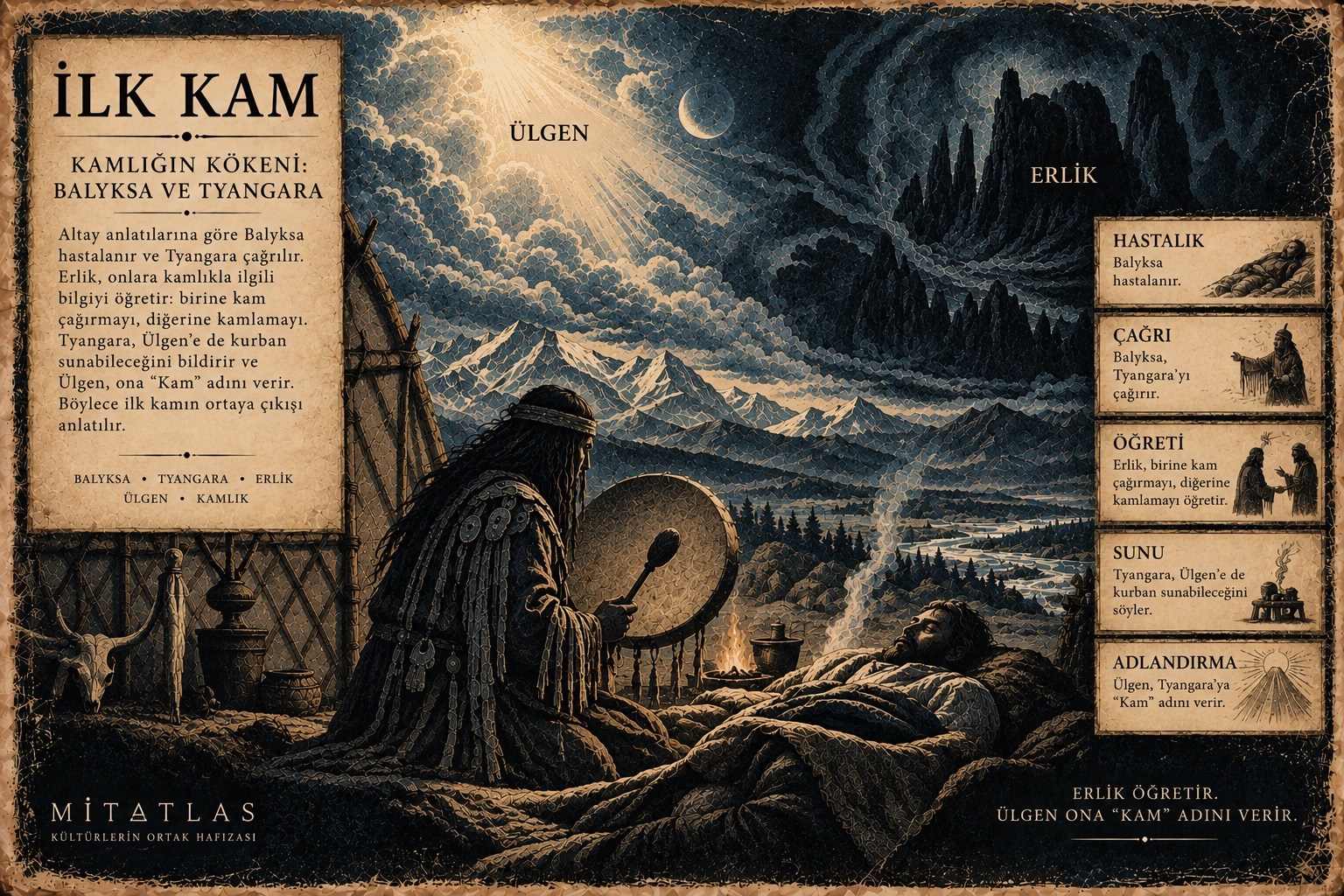
One of the most striking parts of the Erlik narrative explains the origin of kam ritual. Balyksa becomes ill and calls a person named Tyangara. According to the story, Erlik teaches each of them what to do: Balyksa is taught to summon a kam, while Tyangara is taught to perform the ritual.
When Ülgen learns of this, he declares that Balyksa will become Erlik’s servant. Tyangara tells Ülgen that he can offer sacrifices to him just as he has offered them to Erlik. Ülgen then gives him the name “Kam.”
Erlik teaches the practical knowledge of the ritual; Ülgen gives the name “Kam.”
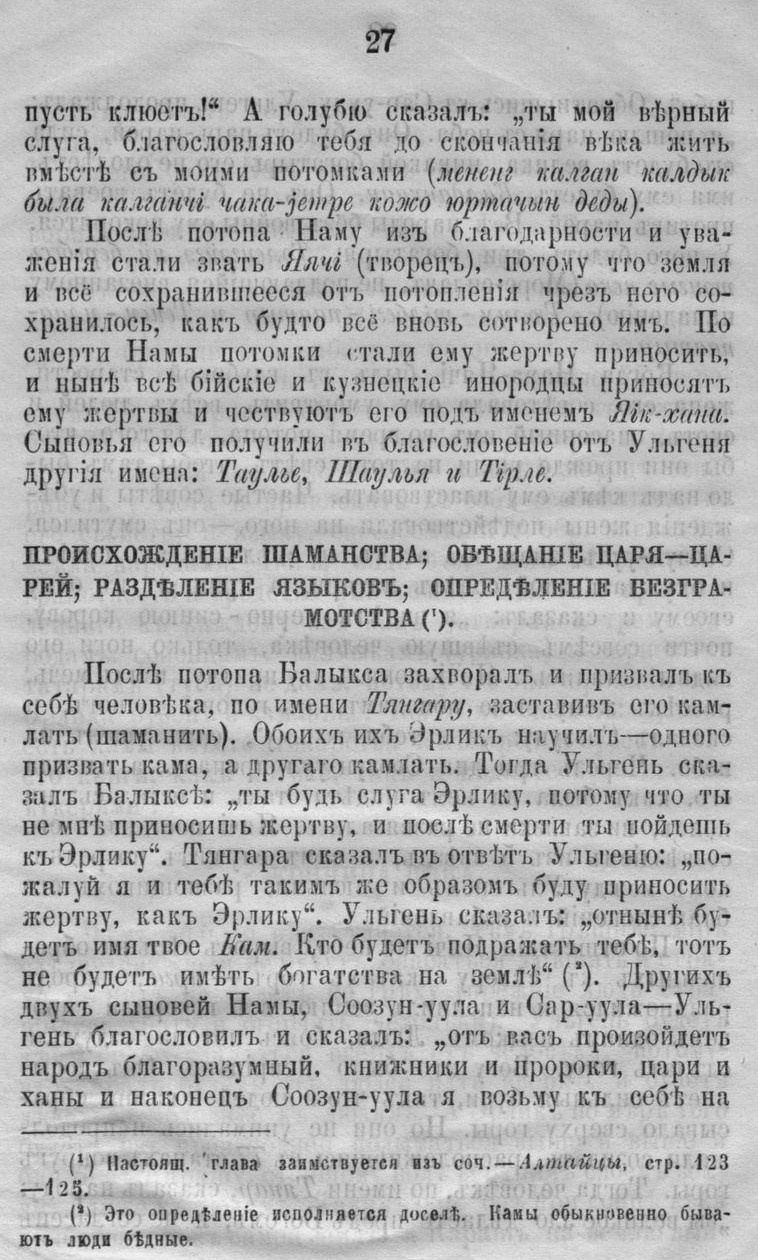
The source history of this section also matters. A footnote in the text published under Landyshev’s name in 1886 explicitly states that the section on the origin of shamanism was taken from pages 123–125 of Verbitskiy’s Altaytsy, published in 1870. The 1870 and 1886 texts should therefore not be counted here as two independent ethnographic witnesses.
Erlik and the End of the World
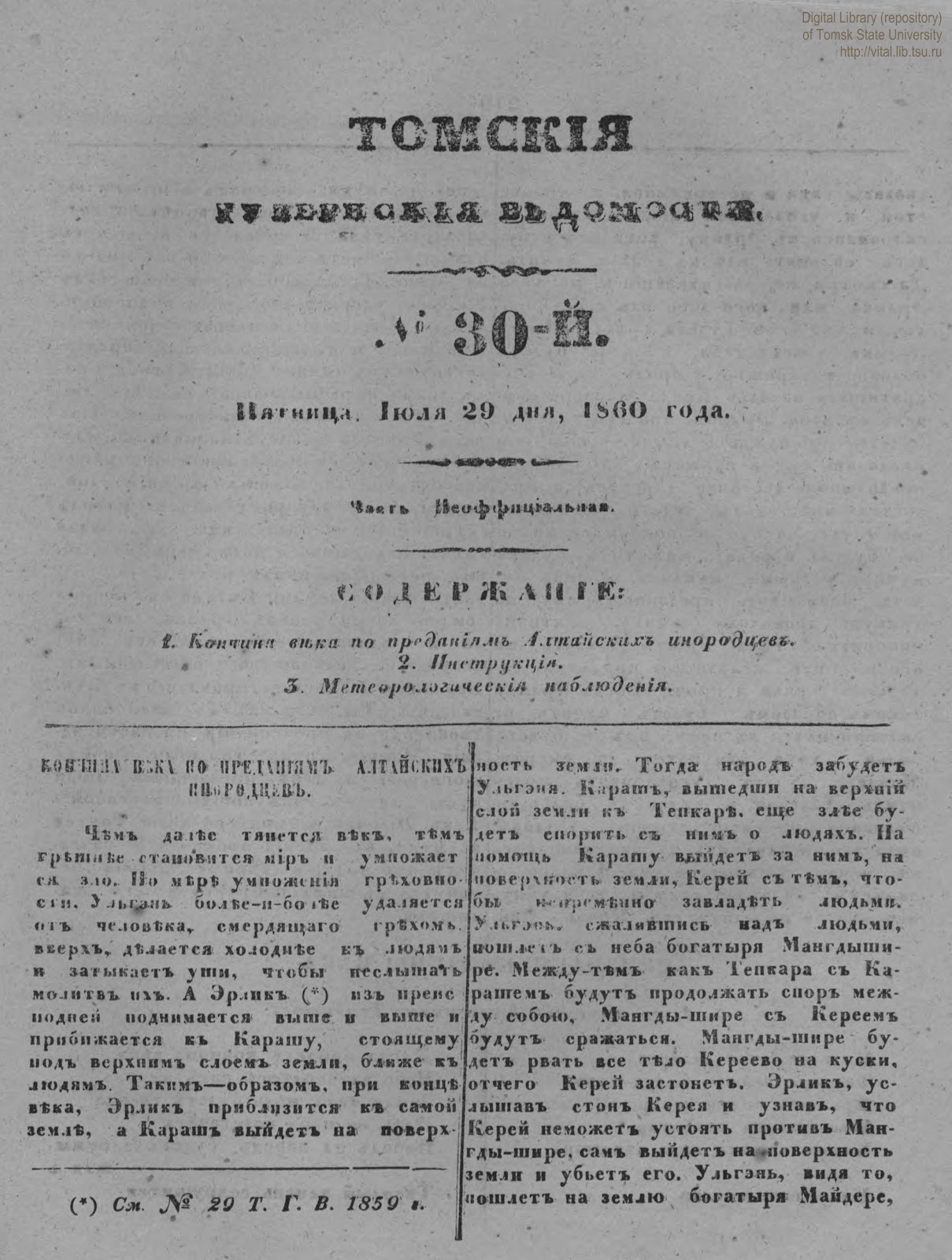
Erlik’s part in the narrative does not end with his banishment to the underworld. In variants describing the end of the world, human sin and evil are said to increase as the age advances. Ülgen withdraws further from humanity, while Erlik approaches from below.
Karaş emerges onto the earth. Figures such as Kerey and Mangdı-Şire take part in the final conflict. Maidere then arrives and warns people to remain loyal to Ülgen. Erlik eventually kills Maidere.
Fire rises from Maidere’s blood, and the world begins to burn. Ülgen descends from the sky and commands the dead to rise. They return to life in their bodies. Fire destroys the polluted upper layer of the old world, and Ülgen makes a new world from the clean layer. Erlik and the powers attached to him are finally driven down.
Erlik’s temporary ascent → cosmic conflict → defeat → renewal of the world
How Old Are the Erlik Narratives? Sources and Missionary Influence
Is There Christian Influence?
The Christian parallels in these narratives cannot be ignored. Particularly striking elements include the creation of woman from a rib, the deception of the first humans, prohibition and exile, the division of languages, the destruction of the world by fire, the resurrection of the dead, final punishment and a renewed world.
Two extreme readings are nevertheless problematic. Treating these texts as “pure ancient Turkic beliefs” untouched by outside influence goes further than the evidence allows. So does declaring the entire narrative a later invention by Orthodox missionaries.
A more careful formulation is this: the nineteenth-century records show strong parallels with Christian creation and end-of-the-world traditions. The surviving sources do not, however, always allow us to determine precisely how much a particular element owes to local tradition, earlier cultural contact or missionary transmission.
Who Stood Behind the Narratives?
The preface signed by A. Golubev in Kosmologiya i feogoniya altaytsev-yazychnikov, published under Stefan Landyshev’s name in 1886, provides important information about how these narratives were transmitted.
According to the preface, the underlying text drew on a draft Landyshev prepared in the early 1850s. One of the principal informants was Mikhail Chevalkov. Golubev reports that, before his baptism, Chevalkov had attended ceremonies as a singer and assistant to kams. Efim Kortı is named in connection with other narratives. The preface also notes grammatical and translation corrections made to the copy by Makariy.
We do not, then, possess an “original book of Erlik” preserved exactly as a single narrator spoke it. Local narrators, people with experience of kam ritual, missionaries, translators and editors all participated at different points in the same chain of transmission.
1865: An Intermediate Source That Should Not Be Overlooked
The 1886 preface states that the same group of narratives had already appeared in a freer, shorter form on pages 24–36 of the anonymous Altayskaya tserkovnaya missiya, published in 1865.
This section already contains numerous motifs—creation, Erlik, human transgression, the flood, the origin of kam ritual, languages and the end of the world—before the later, more detailed texts.
Why Is the 1886 Text Not an Independent Second Witness?
Finding the same passage in works published in 1870, 1886 and 1893 can initially suggest that three separate witnesses confirm the same narrative. The 1886 publication’s own footnotes show that this is not always the case.
One footnote connects the passage from a particular point around the battle with Mangdı-Şire through the end of the Tyurun-Muzıkay narrative to pages 118–121 of Verbitskiy’s 1870 Altaytsy.
Another footnote, in the section on the origin of shamanism, is even more explicit:
“This section is taken from pages 123–125 of the work Altaytsy.”
1893: The Same Narrative, but Not the Same Text
The 1893 Altayskie inorodtsy brings earlier material together again, but it is not a word-for-word copy of the older texts.
The 1886 text describes Erlik being brought to life by a breath blown into his ear; the 1893 version removes this detail. In 1886, Erlik is described as close to Ülgen “like his own brother”; the 1893 text directly says “younger brother.”
By contrast, the account of Erlik’s servants falling from the sky “like hail and rain” and becoming the owners of the places where they land is preserved in very similar form. The core of the first-kam narrative—Erlik teaching one person to summon a kam and the other to perform the ritual—also remains largely the same.
The changes in the section on the end of the world are greater. Some participants’ roles are altered, details are added, and theological terminology is revised. One notable example is the replacement of “bodiless devils” in the 1886 version with “bodiless evil spirits” in 1893.
Is There One “True Legend of Erlik”?
The available sources do not support the idea of a single, fixed text. What we have is better understood as a family of narratives transmitted over time.
Certain core elements recur:
- Erlik’s opposition to Ülgen
- His establishment of a world of his own
- His conflict with Mangdı-Şire
- The fall of his servants
- The emergence of eezi or owner-beings
- His relationship with kam ritual
- His return at the end of the age
The sources differ, however, in how Erlik is brought to life, how his relationship with Ülgen is described, who performs particular roles in certain battles, the intensity of Christian terminology, and the arrangement of sections.
MitAtlas does not aim to erase these differences and manufacture a single “legend of Erlik.” The aim is to show the shared core while keeping the points of divergence visible.
Conclusion: How Should We Describe Erlik?
Defining Erlik only as a “god of the underworld,” “god of death” or “god of evil” narrows the picture presented by historical Altai sources too far.
In the variants examined here, Erlik begins close to Ülgen but gradually turns against him. He intervenes in the human world, establishes a cosmic domain of his own, forges servants, and fights Mangdı-Şire. The beings who fall with him become the eezi of different parts of nature and human settlement. He is presented as the first teacher of kam ritual and rises to the earth again at the end of the world.
None of this removes Erlik’s dark side. Death, illness, punishment, harmful beings and the lower world remain powerful features of his narratives. They simply do not exhaust his meaning.
In some Altai narrative traditions, Erlik is a many-layered figure opposed to Ülgen: associated with the lower world and death, yet also active in creation, transformation, kam ritual and the formation of the cosmic order.
Understanding Erlik means more than reading the legends told about him. It also means tracing the people, languages, translations and publications through which those legends have reached us.
Principal Russian Sources Translated and Compared for the Turkish Edition
V. I. Verbitskiy. “О происхождении Эрлика, Мангды-шире и других разумных существ.” Томские губернские ведомости, 1859, no. 14, pp. 115–118.
V. I. Verbitskiy. “Кончина века по преданиям алтайских инородцев.” Томские губернские ведомости, 1860, no. 30, 29 July, unofficial section, pp. 218–222.
V. I. Verbitskiy. Алтайцы. Tomsk: Gubernskaya tipografiya, 1870, [2], 224 pp.
Russian State Library catalogue record
S. V. Landyshev. Космология и феогония алтайцев-язычников. [Kazan: University Printing House], 1886, 31 pp.
Tomsk Electronic Library — 1886 separate edition
V. I. Verbitskiy. Алтайские инородцы: сборник этнографических статей и исследований... Edited by A. A. Ivanovskiy. Moscow: A. A. Levenson, 1893, XIV + 221 + [5] pp.
Tomsk Electronic Library — original 1893 edition
Other Early and Supporting Sources
V. Verbitskiy. “Заметки кочевого алтайца.” Вестник Императорского Русского географического общества, 1858, vol. 24, part II, pp. 77–109.
Russian Geographical Society digital copy
Алтайская церковная миссия. St Petersburg, 1865. Relevant section: pp. 24–36.
Томские губернские ведомости, 1869–1870. Includes earlier newspaper instalments of many sections later collected in Verbitskiy’s 1870 Altaytsy. Particularly relevant here are 1869 no. 47, pp. 8–9; no. 49, pp. 6–7; no. 50, pp. 6–7; no. 51, pp. 4–5; and 1870 no. 3, p. 8.
N. A. Nepomnyashchikh. “Рассказ А. И. Макаровой-Мирской ‘Камланье’: историко-литературный комментарий.” Сибирский филологический журнал, 2024, no. 1, pp. 123–132. DOI: 10.17223/18137083/86/9.
A Final Note on the Use of Sources
A passage that reappears in a later text has not automatically been counted as a second, independent witness.
Terms such as “devil,” “hell” and “evil spirit” in Russian missionary texts have not been accepted without qualification as ancient Altai terminology.
Where possible, the sources have been considered together with the earliest accessible witness, the original printed page, the chain of transmission, the narrator, translation and editorial intervention.
The aim is not to construct a “pure and unchanged single legend of Erlik,” but to present the historical core of the narratives, their variants and the ways in which they reached us together.