Türkçe: Özgün makaleyi okuyun · English edition
Ülgen is often introduced as a “god of goodness,” a “sky god,” a “creator god” or “Erlik’s opposite.” Those descriptions can reflect features of particular narratives. Read closely, however, the sources reveal traditions recorded among different Altai communities at different times, rather than one fixed character portrait.
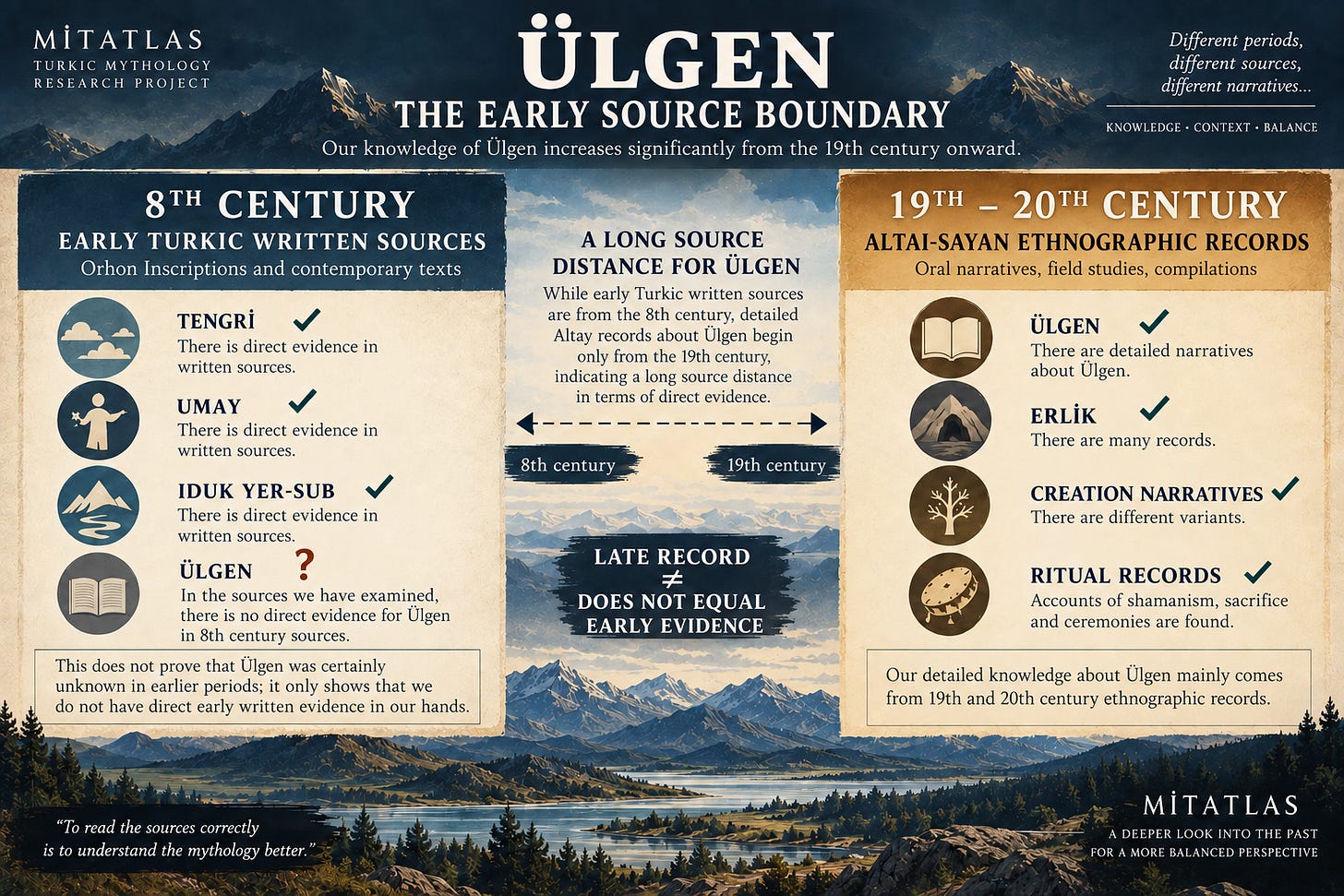
Much of the detailed evidence is relatively late. The richest narrative and ritual material is concentrated in nineteenth- and twentieth-century ethnographic records from the Altai-Sayan region. Our opening question must therefore be more precise than “Who is Ülgen?”: whose Ülgen, in which source, period and community?
This article uses “Turkic” for the broader historical and linguistic world, rather than only the modern Turkish nation. It retains the distinctions and research limits of MitAtlas’s Turkish original.
1. Where does our knowledge come from?
Dates are especially important. Wilhelm Radloff’s Altai oral narratives, published in 1866, form part of the significant nineteenth-century collecting tradition. [S1]
Radloff’s creation variant differs from the one published by V. I. Verbitsky in 1893. A modern comparison notes that Radloff’s text begins with the name Kuday; later, the creator figure is also called Ülgen (Kuday). Verbitsky’s account follows another sequence of events. These are variants, not interchangeable copies of a single text. [S6]
A. V. Anokhin adds another layer to the source history. According to the Kunstkamera catalogue, his 1924 publication draws on material about ritual specialists and belief collected during Altai fieldwork in 1910–1912. [S4]
Our evidence thus comes from a chain of oral narratives, field collections, ethnographic writing and subsequent academic comparisons. It does not come from one ancient sacred book defining Ülgen for every community.
2. Early evidence and later ethnography
One of the greatest risks is to read a story recorded in the nineteenth or twentieth century as an unchanged account of the much earlier Turkic world.
The research behind the Turkish article did not verify a direct attestation of Ülgen’s name in the early Turkic written sources it examined. Detailed accounts become prominent in nineteenth-century Altai-Sayan records. The absence of a verified early written attestation does not prove that Ülgen was unknown then; it marks the limits of the evidence currently in hand.
Conversely, a late narrative does not prove that all its details existed in the same form a thousand years earlier. A later record is not automatically evidence for an earlier period. This matters when comparing Ülgen with Tengri, Umay and sacred Yer-Sub, terms encountered directly in early Turkic inscriptions.
3. “The Altaians” are not a single homogeneous community
The Türk Dünyası Ansiklopedisi places the Tubalar, Chalkanduns and Kumandins among northern Altai communities, and the Altai-Kizhi, Telengits, Teles and Teleuts among southern ones. [S7]
Their historical territories, languages, neighbours and ethnographic records are related, but not identical. A Teleut depiction of Ülgen should not automatically be applied to the Chalkanduns, Tubalar or Altai-Kizhi.
Similar divine names across communities do not establish that every narrative reproduces an unchanging “Altai pantheon.” Local variation is part of the material we need to explain.
4. Ülgen in creation narratives
Creation is among Ülgen’s best-known associations, but there is no single standard story. Radloff’s collected creation narrative begins with Kuday and Kishi. As it develops, the creator is also referred to as Ülgen (Kuday). This variant includes an earth-diver motif: a descent into the water to bring material from below for the formation of land. [S6]
The variant published by Verbitsky in 1893 has a different structure. The comparative study specifically notes that it does not contain the earth-diver motif found in Radloff’s account. [S6]
The defensible conclusion is therefore that multiple creation variants exist, in which Ülgen takes different roles. Combining their details into one seamless “original myth” would conceal their differences.
5. Ülgen, kam traditions and ritual
Ülgen appears in accounts of ritual as well as cosmogony. Kam is a term associated here with a ritual specialist; “kam traditions” refers to the locally recorded practices rather than a universal system shared unchanged by all Turkic peoples.
Anokhin’s 1924 study publishes material from his 1910–1912 fieldwork and includes subjects such as divine beings, sacrifices and ritual texts. [S4] Its existence is important evidence for studying Ülgen in ritual settings.
It does not justify a single ritual template for all Altai communities. Practices and local narratives can differ by place, group and period. Online descriptions claiming that “the Ülgen ritual was performed exactly like this” should therefore be checked against their particular source.
6. Ülgen and Erlik: simply good against evil?
Popular retellings often reduce the relationship to a formula: Ülgen is good; Erlik is evil. The sources and comparative scholarship offer a more complex picture.
Some narratives associate Ülgen with the celestial and benevolent, and Erlik with the underworld and death. Yet their relationship does not always take the form of warfare between two independent, absolute powers.
A 2021 study argues that conflict and cooperation can operate together in different creation variants, and that the opposition cannot be read solely as absolute good fighting absolute evil. [S9] That is a modern academic interpretation. It should not be presented as the fixed doctrine of every Altai community.
7. Was Ülgen imagined as male or female?
Some Altai records imagine Ülgen in male form. A later academic study, drawing on earlier literature, reports that southern Altai Teleuts described Ülgen as a female divine being. [S8]
The distinction in access is important: this information came through secondary scholarship, not a nineteenth-century Teleut field text directly inspected for the article. It must be stated with that limitation.
Neither “Ülgen was really female” nor “Ülgen was certainly male everywhere” adequately captures the variation in the records.
8. Can we reconstruct Ülgen’s true appearance?
Sources may describe age, beards, clothing or human form. But details from different traditions cannot simply be assembled into one definitive historical portrait. An attribute in one account need not be a permanent feature in another.
White-bearded portraits and other fixed modern images should not be treated as the one authentic appearance supplied by the sources. MitAtlas’s visual interpretations likewise make no claim to reconstruct a verified historical likeness. They are contemporary artistic responses to the narratives.
9. What can we say with confidence?
- Ülgen is important in nineteenth- and twentieth-century ethnographic, folkloric and ritual records from the Altai-Sayan region.
- In some creation variants, Ülgen is a creator or a major participant in creation.
- There are records connecting Ülgen with kam traditions and ritual.
- Traditions differ among Altai communities.
- The relationship with Erlik is too varied to reduce to one universal good–evil opposition.
- No single historical model of gender or physical appearance fits every account.
The same material does not establish that all early Turkic peoples shared one Ülgen belief, that every Altai community performed the same ceremonies, or that we know Ülgen’s definitive historical appearance.
10. A tradition that cannot be reduced to one portrait
The same name can occur in different communities; related creation motifs can appear in different stories. One record may imagine a figure as male, another transmitted account as female. Ülgen and Erlik may oppose one another in one narrative and take different roles in another.
This diversity is not a mistake in mythology. It reflects oral traditions, local communities and historical change. The useful question remains: which Ülgen, in which source, at what time and among whom?
MitAtlas aims to make those distinctions visible without diminishing the stories or making the sources say what they do not say.
Sources and access notes
These sources have different statuses: historical collections, ethnographic works, catalogue records and modern comparisons should not be treated as equivalent. Access descriptions below refer to the research behind the Turkish original, not to a new field study conducted for this translation.
- S1 — Wilhelm Radloff (1866), Proben der Volkslitteratur der türkischen Stämme Süd-Sibiriens. Historical collection; a digital copy was checked.
- S2 — V. I. Verbitsky (1893), Altayskie inorodtsy. Historical ethnographic source available as a digital scan.
- S3 — G. N. Potanin (1883), Ocherki Severo-Zapadnoy Mongolii, IV. The bibliographic record and modern academic transmission of relevant narratives were checked.
- S4 — A. V. Anokhin (1924), Materialy po shamanstvu u altaytsev. Historical ethnographic study based on 1910–1912 Altai fieldwork; the Kunstkamera record supports this description.
- S5 — L. P. Potapov (1991), Altayskiy shamanizm. Historical and ethnographic synthesis; linked through the Russian National Electronic Library catalogue.
- S6 — Comparative study of Radloff’s and Verbitsky’s creation variants (2023). Used for differences in names, narrative structure and motifs.
- S7 — Türk Dünyası Ansiklopedisi, “Altay Türkleri.” Used for the northern/southern classification of Altai communities.
- S8 — Modern academic study reporting female descriptions of Ülgen among the Teleuts. Used as secondary transmission based on earlier literature, not a directly examined field record.
- S9 — Comparative study of Ülgen and Erlik (2021). Source for the modern interpretation that their relationship is not reducible to absolute good versus evil.
- S10 — Modern study of the Ülgen–Erlik opposition (2022). Supplementary scholarship on cosmological opposition and complementarity.
This article is not a new epigraphic reading or independent field investigation. It adapts a comparison of historical collections, available digital copies, bibliographic records and modern scholarship. Later attestation alone cannot prove unchanged earlier existence.
Source links retained from the Turkish article
- S1: linked source or catalogue record
- S2: linked source or catalogue record
- S3: linked source or catalogue record
- S4: linked source or catalogue record
- S5: linked source or catalogue record
- S6: linked source or catalogue record
- S7: linked source or catalogue record
- S8: linked source or catalogue record
- S9: linked source or catalogue record
- S10: linked source or catalogue record