Türkçe: Özgün makaleyi okuyun · English edition

Translating kut, also written qut, into one English word can seem straightforward: sacred power, fortune, happiness, or a ruler’s divinely granted authority. Each can touch part of its historical usage. None should automatically stand for every occurrence.
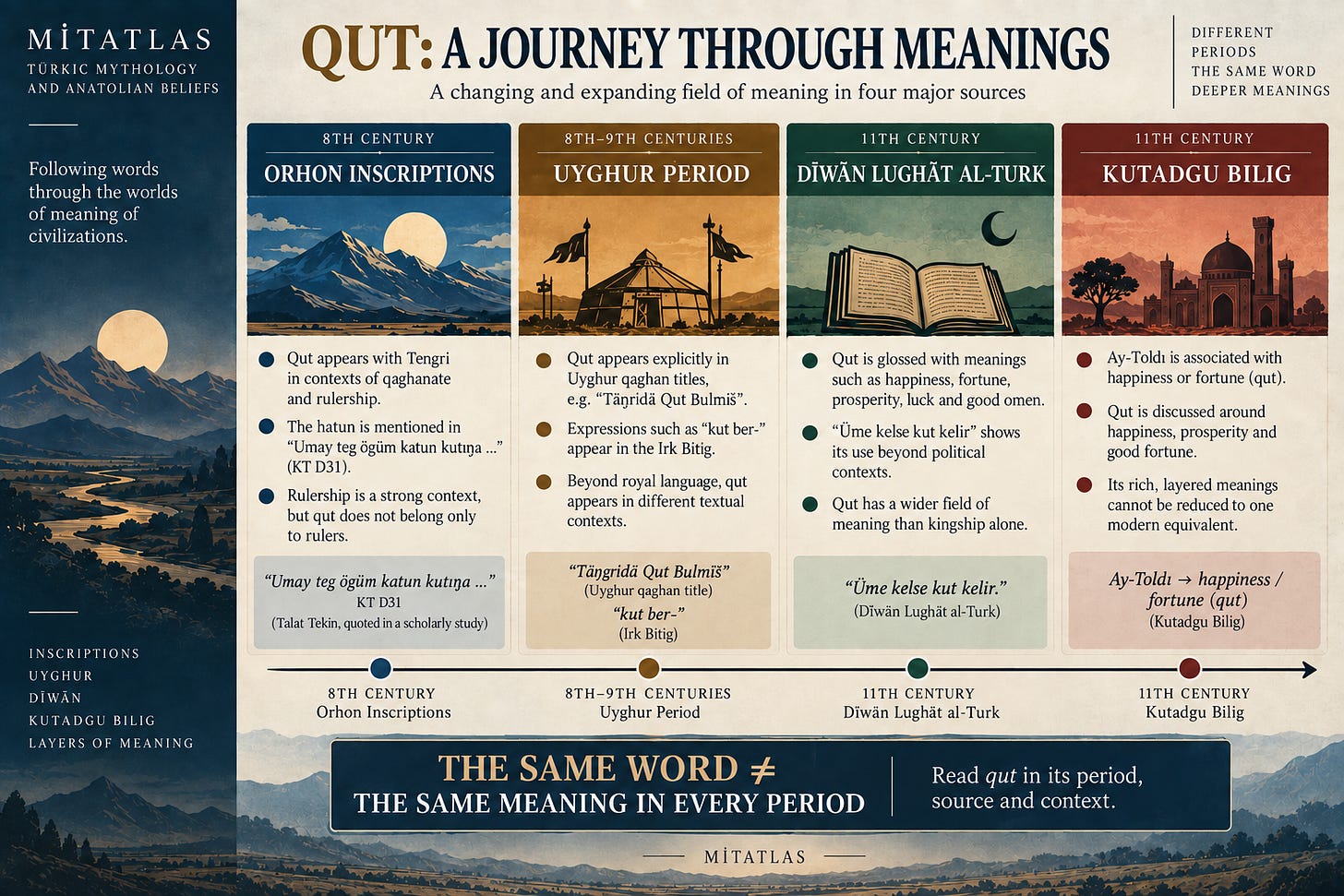
From eighth-century Turkic inscriptions through Uyghur material to the eleventh-century Dīwān Lughāt al-Turk and Kutadgu Bilig, the evidence becomes more complex. Qut appears in royal contexts, but an inscription also mentions the qut of a royal woman. Later texts make its associations with fortune, auspiciousness and well-being especially visible.
Rather than asking only “What is qut?”, this English adaptation of MitAtlas’s Turkish research asks: what does it mean in this source, at this time and in this context? “Turkic” here refers to a wider historical and linguistic world than modern Turkey.
1. Qut in the inscriptions: Tengri and kingship
Some of the important early attestations occur in the Orkhon inscriptions. In the Kül Tigin and Bilge Qaghan texts, qut appears in narratives concerning kingship, a ruler’s success and Tengri. Passages in which Bilge Qaghan refers to his own qut while explaining his accession provide a substantial textual basis for connecting the term with rulership. [S1]
The association with political authority and legitimacy is therefore not simply a modern invention. Faruk Manav’s 2024 study examines qut as a foundation of political legitimacy in the inscriptions. This is the researcher’s historical and political interpretation of the evidence. [S2]
We must nevertheless distinguish occurrence from definition. Finding qut in a royal passage is not the same as proving that it always meant “the right to rule bestowed by Tengri” throughout history.
Vladimir V. Tishin’s 2022 study revisits that familiar explanation. He argues that a sovereignty-based reading may be possible in some runic contexts without being necessary in every instance. His alternative is to understand qut as a “life force” or a kind of “energy.” [S3] This is Tishin’s scholarly thesis, not an undisputed dictionary definition.
2. Did qut belong only to the qaghan?
Line 31 on the east face of the Kül Tigin inscription is particularly valuable for testing an exclusively royal-male interpretation. Bilge Qaghan associates his mother with Umay and refers to the qut of his mother, the qatun, in the same passage. [S1]
Umay teg ögüm katun kutıŋa...
This is the phrase cited in the Turkish article as KT D31; D abbreviates Turkish doğu, “east.” Translation and interpretation must be checked against the edition being used.
The limited but important point is that the word is not used only of the qaghan: a qatun’s qut can also be mentioned. This does not establish a new universal rule that Umay always bestowed qut in the early Turkic world.
The passage contains Umay, a mother or royal woman, and qut. Their occurrence together should be preserved as evidence without turning the sentence into an entire reconstructed theology.
3. Qut in the Uyghur world
The term did not disappear after the Göktürk inscriptions. The Karabalgasun inscription, an important monument of the Uyghur Qaghanate, was composed in Old Turkic, Sogdian and Chinese and is associated with the eighth Uyghur qaghan. [S4]
The ruler’s title is recorded in the form:
Ay Tängridä Qut Bulmïš Alp Bilgä Qaγan
Qut clearly remained part of Uyghur royal language. [S4] But a preferred modern rendering of Qut Bulmïš should not be presented as if it were the inscription itself: interpreting the expression requires philology.
The Old Turkic portion of the monument is also highly fragmentary. The condition in which a source survives constrains what we can conclude. [S4]
Uses such as kut ber- in Old Uyghur texts and the Irk Bitig offer further reasons not to confine the word to royal terminology alone. [S7]
4. Fortune arrives: qut in the Dīwān
The eleventh century brings a different type of source. Mahmud al-Kashgari’s Dīwān Lughāt al-Turk contains usages that broaden the discussion beyond kingship. [S5] One striking proverb is:
Üme kelse kut kelir.
Academic discussions explain it through the relationship between a guest’s arrival and the arrival of good fortune or auspiciousness. There is no qaghan, accession or account of political legitimacy in that setting.
Such examples show that the word could occupy a semantic field including luck, fortune, prosperity and auspiciousness in eleventh-century Turkic vocabulary. [S5]
Chronology must remain visible. The Dīwān belongs to the eleventh century; the Orkhon inscriptions to the eighth. A later usage does not automatically supply the meaning of every earlier occurrence. Equally, a royal context in the inscriptions cannot explain every occurrence in the dictionary as political sovereignty. We are following the same word through different contexts.
5. Kutadgu Bilig: happiness, prosperity or political order?
Yusuf Khass Hajib’s Kutadgu Bilig is another important stage. The TDV İslâm Ansiklopedisi describes its four principal figures through their representative roles: Kün-Toğdı and just law, Ay-Toldı and happiness or fortune (kut), Ögdülmiş and reason, and Odgurmış and life’s end. [S6]
An English reader also needs to understand a difficulty in modern Turkish discussions. The word devlet today commonly means the political state, but historical uses can refer to fortune, prosperity or felicity. Translating every instance as “state” can therefore distort the discussion.
Neither “qut means only the state” nor “qut means only happiness” adequately captures the layers of meaning under investigation. Showing the semantic range is safer than insisting on a single modern equivalent. [S6]
6. Could qut mean “life force”?
Historical dictionaries and some later Turkic-language evidence record meanings connected with soul or life. [S7] A meaning attested in a later language, however, cannot be transferred automatically into a much earlier text.
Tishin approaches the runic evidence by reconsidering its occurrences together. He notes the usual explanation of qut as a power Heaven gives a ruler and which is associated with sovereignty. He then argues that this reading, though possible in some contexts, is not required in all of them. His alternative is a life force or kind of energy that different living beings may possess. [S3]
Two absolute statements should therefore be avoided: “qut is certainly only the authority to rule” and “its real meaning is certainly life energy.” The second is a modern reinterpretation challenging the first, not a final consensus. Its value lies partly in opening new questions about the texts.
7. What is secure, and what remains interpretive?
Well-supported points:
- Kut/qut is attested in early Turkic inscriptions. [S1]
- It occurs in contexts involving rulership and Tengri. [S1–S2]
- An early passage mentions a qatun’s qut. [S1]
- Qut occurs in Uyghur royal titles. [S4]
- Eleventh-century sources attest associations with fortune, happiness and auspiciousness. [S5–S6]
- Qut is a central concept in Kutadgu Bilig. [S6]
Questions requiring interpretation: the best modern translation in each early passage; the theoretical nature of its relationship with rulership; and how far the life-force explanation can be applied to runic texts.
Claims not established by the evidence used here: that all Turkic communities understood qut identically; that it belonged only to rulers; that it was always acquired or lost through the same ritual; that it was a physical or uniformly defined mystical object; or that it named one detailed doctrine unchanged through history.
Acknowledging these limits is part of the result, not a gap to be filled with certainty.
8. One word, changing worlds of meaning
We began by looking for a definition and arrived at a history of meanings. Qut belongs in the language of kingship, but does not appear confined to it. It occurs alongside Tengri; a qatun can possess it; Uyghur rulers retain it in their titles. In the Dīwān, luck and auspiciousness come into view. In Kutadgu Bilig, it belongs to a broader reflection on fortune and human well-being.
Scholars continue to debate how particular early occurrences should be read. MitAtlas’s cautious conclusion is that the term’s long and layered history cannot be contained in one modern word. Qut shows how an enduring word can acquire different emphases in different texts and periods.
Sources and access notes
These notes preserve the distinctions in the Turkish article. A citation does not mean every original work was independently read in full for this adaptation.
- S1 — Talat Tekin, Orhon Yazıtları. Text and translation tradition for the Kül Tigin and Bilge Qaghan attestations. The original article focused on KT G9 / BK K7, KT D29 / BK D23 and KT D31, cross-checking readings through academic quotations. Translation details may differ between editions.
- S2 — Faruk Manav (2024), “Orhon Yazıtları’nda Siyasal Otoritenin/Egemenliğin Meşru Zemini Olarak Kut: Weberci Karizma Açısından Değerlendirme,” folklor/edebiyat, 30(119), 555–574. Used as an academic interpretation of legitimacy, not as the ancient text itself. Study.
- S3 — Vladimir V. Tishin (2022), “A Term Qut in the Monuments of Old Turkic Runic Writing Revisited,” 27(2), 105–120. The life-force proposal is presented as an alternative interpretation. Study.
- S4 — Yutaka Yoshida, “Karabalgasun: The Inscription,” Encyclopaedia Iranica. Used for the trilingual monument, its ruler and the royal title, with attention to the fragmentary Old Turkic section. Entry.
- S5 — Mahmud al-Kashgari, Dīwān Lughāt al-Turk, through scholarship drawing on the edition of Ahmet Bican Ercilasun and Ziyat Akkoyunlu. The proverb and semantic range were cross-checked through academic studies, not a complete independent critical-edition analysis of every relevant entry.
- S6 — “Kutadgu Bilig,” TDV İslâm Ansiklopedisi. Used for the four representative figures, Ay-Toldı’s association with kut and the title’s explanation, alongside philological discussion. Entry.
- S7 — Gerard Clauson (1972), An Etymological Dictionary of Pre-Thirteenth-Century Turkish, qut entry, p. 594. Used to compare historical meanings across Orkhon, Old Uyghur, the Dīwān and Kutadgu Bilig. Later soul/life-force meanings were not automatically projected backwards.
Historical attestation, philological explanation and modern scholarly interpretation have different evidential statuses. This article may be revised as stronger evidence becomes available.