
Short answer
Inanna’s Descent is a Sumerian literary composition preserved through multiple witnesses. Inanna passes seven gates, loses her powers, dies and is revived through Enki’s helpers. Release requires a substitute, continuing the story with Dumuzi. The Akkadian Ishtar composition is related but must be read as separate evidence.
Inanna’s Descent follows a goddess into the netherworld, through the loss of her powers and an extraordinary return. Its seven gates are memorable, but the surviving sources offer more than a sequence of symbols. They also raise questions about authority, loyal assistance, and the cost of leaving. Reading the Sumerian composition beside its evidence helps separate the story from the explanations later readers give it.
This guide uses the familiar spelling Inanna; Oxford’s ETCSL writes Inana. The Sumerian composition is our main narrative. An Akkadian witness to Ishtar’s descent appears separately below. Neither is treated as a transcript of a historical journey.
What text are we reading when we read Inanna’s Descent?

A modern continuous text can conceal a very discontinuous survival. The ETCSL bibliography identifies numerous cuneiform witnesses alongside the editions, translations, and earlier electronic material used by its editors. Its readable English page is therefore an edited composite, rather than a photograph of one complete ancient tablet. Parentheses marking a manuscript’s addition matter: they expose a choice or difference that a smooth retelling might hide. [2]
One concrete example is CDLI P275001, catalogued as N 0983 joined with N 7710 in the Penn Museum. The record identifies a Sumerian literary witness from Nippur and assigns it to the Old Babylonian period, approximately 1900–1600 BCE. Its visible transcription includes broken passages. That is evidence for a particular surviving object, not a date for the first performance, composition, or circulation of every part of the story. [6]
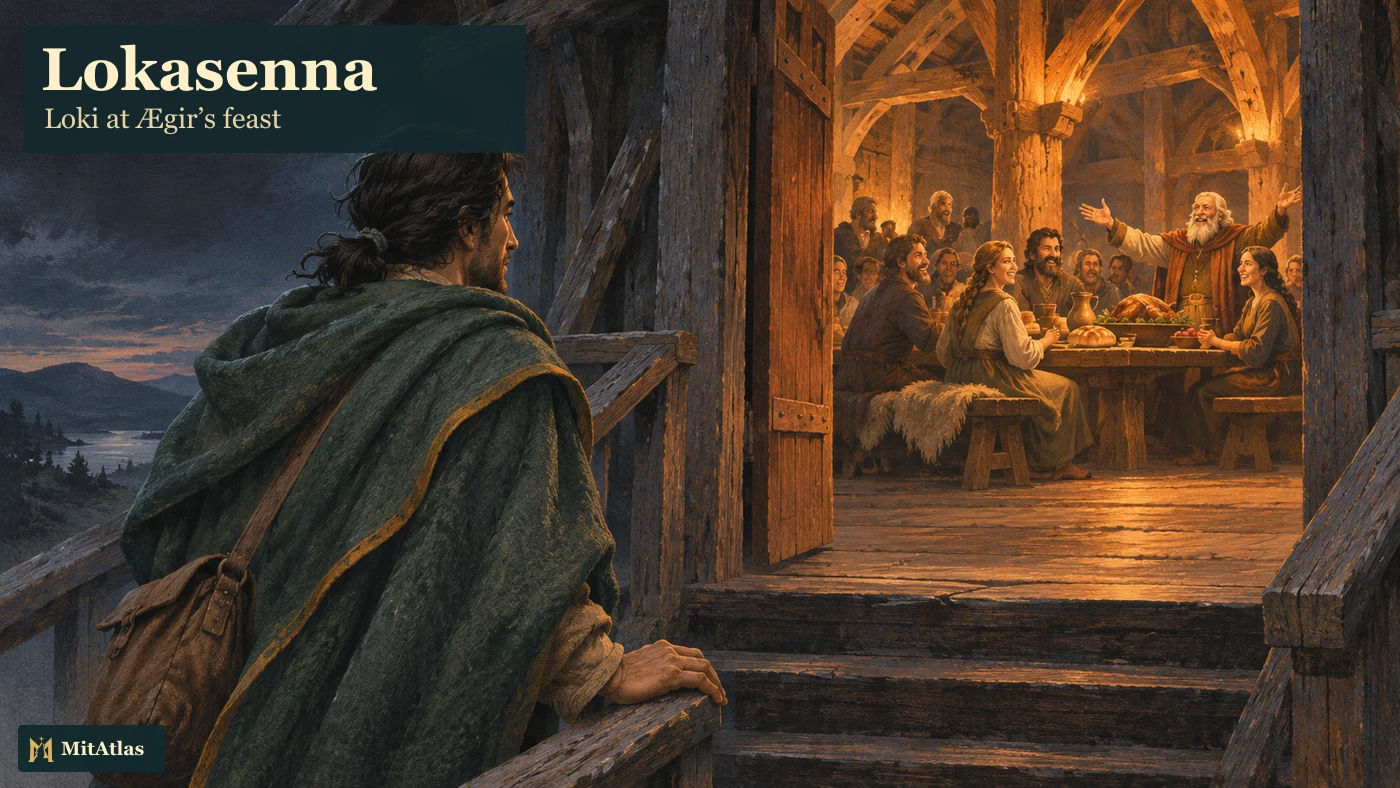
Keep three questions separate: what an object preserves, what an editor reconstructs, and how a reader interprets the result. An artifact number answers a different question from a poem’s title. For a useful comparison of this reading habit across another tradition, see our guide to Lokasenna’s verse and prose frame; the comparison concerns method, not a shared origin.
What does Inanna arrange before she goes below?

Inanna leaves her offices and sanctuaries, equips herself, and gives Ninshubur instructions for seeking help if she does not return. At the entrance she tells Neti that she has come for the funeral observances of her sister’s husband. This is her explanation to a gatekeeper; it need not settle every question about her purpose. The opening and the dialogue are different kinds of narrative evidence. [1: lines 1–89]
The larger religious setting also resists a simple personality label. Ira Spar’s Metropolitan Museum overview describes Mesopotamian divine traditions across a very long period, relating gods to cities, political decisions, and material culture. A goddess can belong to several overlapping settings. A brief modern label cannot replace the work of identifying the particular composition in front of us. [8]
For this reading, a practical question is more useful than assigning one timeless motive: what has the protagonist prepared, and which preparations become important later? It keeps attention on decisions within the narrative, rather than on a psychological biography invented outside it.
What changes at the seven gates?

Ereshkigal instructs Neti to admit Inanna through the gates separately. An item is removed at each stage. Her protests meet an explanation invoking the netherworld’s powers and rites; the progression ends with her garment. The text then moves from admission to judgment and death. [1: lines 114–172]
Dina Katz asks whether the gatekeeper’s explanation should be accepted as a universal rule. Her 1995 study argues that earlier textual and archaeological evidence does not support the idea that all the dead necessarily arrived unclothed. She reads the stripping as a measure directed against Inanna and her powers. In that interpretation, the gatekeeper’s appeal to divine order serves a particular confrontation. It is Katz’s argument, not a statement that every scholar has settled the issue in the same way. [3: opening discussion; sections 2.2–2.3]
The distinction changes what the episode can prove. It can show what happens to this visitor in this story. Establishing a general burial practice requires a different body of evidence. Nor does the number seven, on its own, demonstrate a connection to chakras or a prescribed sequence of modern self-development. Such a connection would need its own historical evidence.
Who makes Inanna’s return possible?

Kramer’s discussion gives a useful account of the rescue’s mechanism. Enki sends two helpers with instructions: they respond sympathetically to Ereshkigal’s distress, refuse other gifts, and obtain Inanna’s body. Life-restoring substances make revival possible. Kramer’s article is a historical scholarly reading, published in 1960; it should be read with that date in mind, alongside the later composite edition. [5: p. 67]
The episode invites close attention to assistance rather than treating the protagonist’s return as a solitary achievement. Our illustration concentrates on an exchange between figures, avoiding a depiction of the dead body or an imagined medical procedure. A literary life-giving substance is part of the myth, not a substance identified for readers to obtain or use.
It is also useful to distinguish two outcomes in any summary: becoming alive again and becoming free to leave. Those outcomes need not be identical. Keeping them separate helps explain why a retelling that stops at revival can leave the next part of the composition unexplained.
Why does the story continue with Dumuzi?

Dumuzi’s fate turns that distinction into a difficult continuation. Katz’s 1996 article examines how an Inanna narrative and a Dumuzi narrative may have been joined. She proposes that the Anuna’s intervention in the release links the first story to the second. This is a reconstruction of literary formation, not a surviving document showing an editor making the join. Her opening discussion also compares earlier scholarly proposals instead of presenting a single uncontested solution. [4: opening argument]
The surviving composite makes Dumuzi the substitute and has a damaged ending with a half-year alternation. The gaps limit how fully we can explain the final arrangement from this text alone. [1: lines 347–410] A neat seasonal diagram may be appealing, but it would need support beyond simply dividing a year in two.
That is a useful stopping point for certainty. Readers can follow the narrative consequence without pretending to possess an undamaged ending or a complete account of the work’s composition. The unresolved parts belong to the evidence, rather than being faults that an illustration or confident summary should silently repair.
How should we distinguish Inanna, Ishtar, and later interpretations?

The names Inanna and Ishtar are closely related in Mesopotamian religious traditions, but a shared divine identity does not make two literary compositions interchangeable. CDLI P345482 identifies K.162 as an Akkadian witness to Ishtar’s descent, from Nineveh and the Neo-Assyrian period. Compare that object record with the Sumerian, Old Babylonian witness P275001. Language, surviving object, and catalogue identity provide firm starting points before comparing episodes. [7][6]
Do not use a photograph of K.162 as though it were the tablet behind every line of the Sumerian composite. The catalogue links help locate evidence; no museum photograph is reproduced here. Equally, the editions listed in the Oxford bibliography are routes for further study, not books this guide claims to have consulted in full. [2]
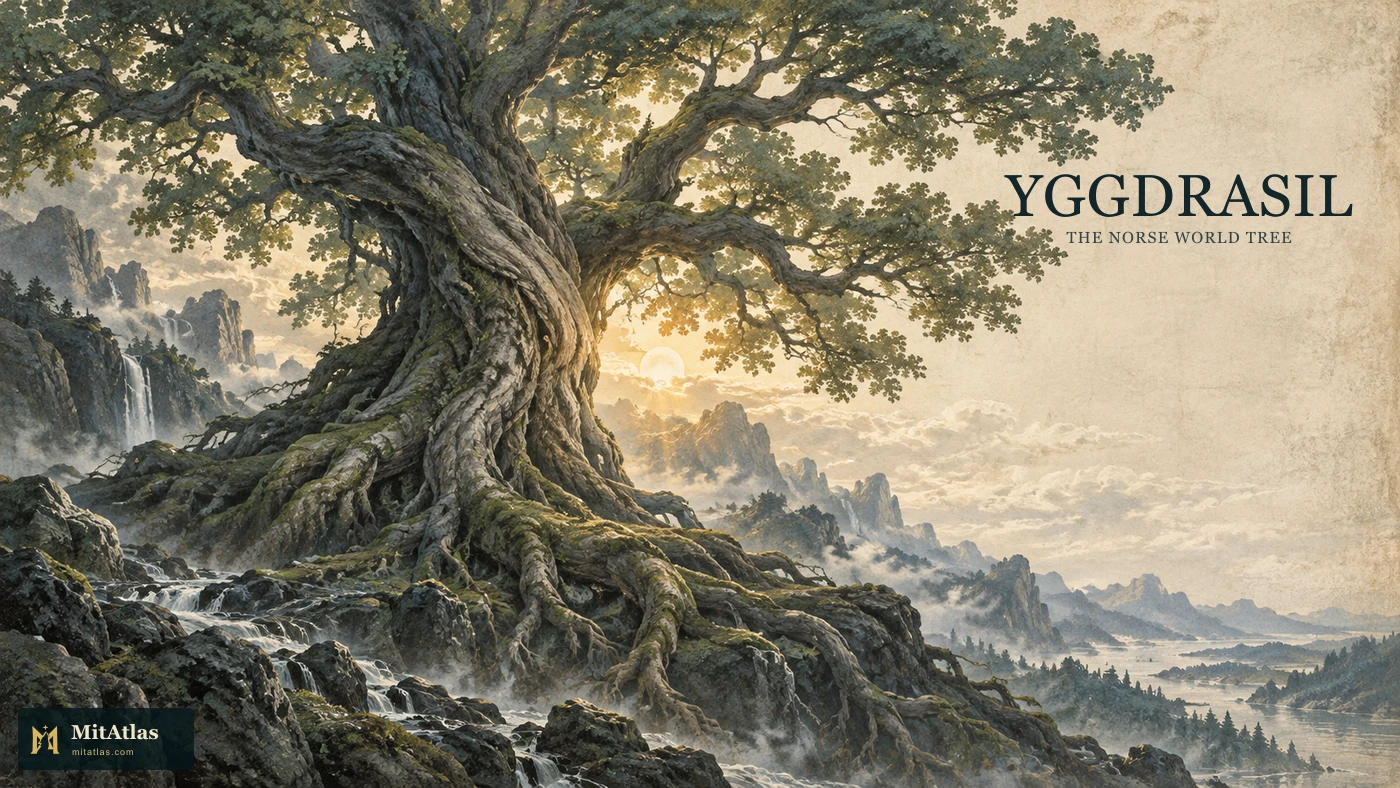
A source-led reading can still be imaginative. It asks us to name the boundary between an ancient narrative, a scholar’s proposal, and our own response. Our accounts of Erlik in Altai sources and Yggdrasil in Norse sources apply that discipline to different traditions. They do not establish that the traditions describe the same underworld. Start with the witnesses, follow the actions, and let an unanswered question remain visible when the text cannot answer it.