
Short answer
Yggdrasil is the Norse world tree, described as an ash in Eddic passages. Poems and prose connect it with roots, wells, creatures and divine judgment, but differ in their accounts. Reading them side by side reveals a living, vulnerable cosmos rather than one fully specified nine-world diagram.
A tree fills the sky, roots reach into different places, a squirrel runs between an eagle and a serpent, and the ancient branches shake when the gods face disaster. Yggdrasil is one of Norse mythology's strongest images. It is also often drawn as though medieval literature had supplied a single complete map of nine worlds.
Yggdrasil is the Norse world tree, described as an ash in the cited Eddic passages. Its roots, wells and creatures connect several stories, but the surviving accounts do not provide one fully specified nine-world diagram. To understand it, we need to keep the poems, Snorri's prose, translations and modern visual summaries apart.
What is Yggdrasil, and which texts describe it?

Yggdrasil is the great tree of Norse myth, a meeting point for divine activity, roots, water and creatures. Calling it the world tree is useful shorthand: its importance extends far beyond the life of an ordinary tree. Yet the texts describe it through particular scenes and relationships, not through a single diagram that answers every geographical question.
In Völuspá 19, the speaker names Yggdrasil, describes the ash beside Urðr's well and associates it with moisture and dew. The next stanza introduces three women who determine lives and laws. In Grímnismál 29–35, the emphasis shifts to the gods' journeys, the roots and the animals troubling the tree. The same tree can anchor different questions within different poems. Bellows, Völuspá 19–20 and Grímnismál 29–35
These poems belong to what is called the Poetic Edda. Snorri Sturluson's Prose Edda, a medieval Icelandic work, is a different literary route. Its Gylfaginning presents myth through questions and answers, arranging material in prose and quoting poetry. The scene in which Gangleri asks about the gods' holy place leads into an account of the tree. This is a narrated exchange, not a modern observer's survey. Anderson, Gylfaginning, numbered paragraph 15
Snorri wrote as a Christian in medieval Iceland, and that context matters when reading his arrangement of inherited myths. Faulkes emphasizes both the work's importance and the influence of its author's beliefs and education. This calls for source comparison, not blanket dismissal. Faulkes 2005, introduction, p. xi
Keeping those forms separate helps us read their details. A poem may rely on allusion, while prose supplies explanations; a translator adds another layer through English word choices and notes. Here the historical English translations of Henry Adams Bellows and Rasmus B. Anderson are checked against relevant passages and notes in Anthony Faulkes's scholarly edition. We do not present a new translation of the surviving Old Norse manuscripts.
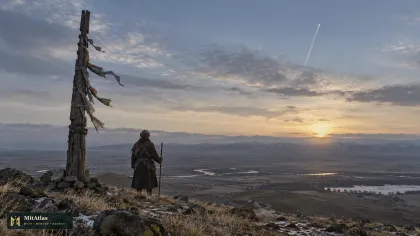
Our images follow the same boundary. They make relationships visible, but their landscape, tree anatomy and arrangement are editorial choices. They are not archaeological reconstructions or images of a particular historical sacred tree.
Roots and wells in different accounts

Grímnismál 31 gives Yggdrasil three roots extending in different directions. Bellows's translation places Hel beneath one, frost giants beneath another and humans beneath the third. That is a compact set of relationships. It does not label nine separate roots, give distances between realms or specify a complete route through the universe. Grímnismál 31
The prose account is not an interchangeable caption for that stanza. In Anderson's translation of Gylfaginning 15, one root is associated with the gods, another with frost giants, and a third with Niflheim. Hvergelmir is associated with the Niflheim root, while Mímir's well lies beneath the root reaching towards the frost giants. The passage then describes the heavenly root and Urðr's well, where the gods hold their court. Gylfaginning 15
The difference matters most at the point where an attractive diagram becomes evidence. Replacing the poem's humans with the prose account's gods, without saying so, makes the reader think that one text supplied the entire arrangement. A better explanation leaves the accounts beside one another rather than silently resolving them.
| Source | Associations in the passage | Reading limit |
|---|---|---|
| Grímnismál 31, Bellows | Hel, frost giants, humans | A short poetic statement, not a nine-world atlas. |
| Gylfaginning 15, Anderson | Gods, frost giants, Niflheim; wells developed in prose | Do not substitute its arrangement for the poem without attribution. |
Water also does more than fill a gap under a root. The prose connects Mímir's well with knowledge, and Urðr's well with divine judgment and the norns. In paragraph 16 the norns tend the tree with water and the substance around the well. The tree is sustained as well as attacked. Gylfaginning 15–16
For a useful first reading, ask what a root or well is doing in its own passage. Is the text explaining a journey, a place of judgment, wisdom, or care? Those questions are more productive than asking a picture to establish a universal north, south, top and bottom.
Animals, damage and the life of the tree

The animals around Yggdrasil are not simply ornaments in a peaceful cosmic garden. In Grímnismál 32, the squirrel Ratatoskr carries words between the eagle above and Níðhöggr below. Stanza 33 names four stags: Dáinn, Dvalinn, Duneyrr and Duraþrór, with spelling variations in English translations. Their feeding is followed by a passage about serpents and then a concise description of the tree's suffering. Grímnismál 32–35
Stanza 35 brings the pressures together: the animal feeding above, the deterioration of the trunk and Níðhöggr gnawing beneath. The tree's greatness does not make it untouched. Reading only the creature list can obscure the passage's movement from inhabitants to damage.
Snorri's prose expands the scene. Anderson's paragraph 16 describes a knowledgeable eagle, a hawk called Veðrfölnir between its eyes, the squirrel moving up and down, and four stags eating foliage. It also gives Níðhöggr other serpents in Hvergelmir and places the norns' care of the tree beside the accounts of harm. Our chapter plate selects the eagle, squirrel, deer and root-serpent relationship; it does not pretend to depict every prose detail. Gylfaginning 16
Faulkes's note to this passage draws attention to differences in animal numbers within the poem and in the prose's use of it. His explanation is a scholarly interpretation of textual variation, not a new event in the myth. That warning gives us a good reason not to treat every line as a perfectly consistent zoological inventory. Faulkes 2005, general notes, p. 62
Nor should we assign every animal a universal modern meaning and call it ancient doctrine. The squirrel's movement and the gnawing below are directly tied to actions in the passage. An interpretation such as communication, conflict or vulnerability can help discussion, but it must remain an interpretation. First locate the creature, then its action, then the source that connects them.
Does the tree provide a complete map of nine worlds?

The number nine belongs to the literary evidence; it is not merely a modern invention. In Bellows's version of Völuspá 2, the speaker remembers nine worlds and connects the image with a tree and its roots. But that short stanza does not enumerate nine named realms in nine positions. Recognizing the number is different from possessing a complete map. Völuspá 2, in Bellows's edition
A diagram has to choose things that a passage may leave open: which names to include, whether two descriptions count as one place, how to represent a root, and how to turn an association into a line on paper. Even an informed drawing therefore contains decisions. Its usefulness depends partly on whether those decisions are visible to the reader.
The root comparison above shows the problem in miniature. Both accounts offer three roots, but their associations cannot simply be swapped. Adding other named places from elsewhere may produce a convenient overview, yet the resulting structure is a synthesis. It is not a recovered plate handed down with the poem.
A good modern nine-world diagram can still be a learning aid. Treat it as a reading tool: ask for the source of each connection, the edition being used, and the points at which the author has organized or simplified uncertain material. A drawing that says what it leaves unresolved can be more informative than one that fills every space.
The same care applies across traditions. Our account of sacred land and water in Old Turkic sources offers a separate way to examine meaningful landscapes. A tree, root or sacred place in two traditions gives us a question for comparison, not proof of identical cosmology or shared origin. Nor is Yggdrasil simply another name for Ötüken's historical sacred homeland. Each belongs to its own source context.
Odin's ordeal and the tree of the poem

A famous passage in Hávamál tells of Odin hanging on a wind-exposed tree for nine nights, wounded by a spear and dedicated to himself. In the Bellows edition used here it begins at stanza 139. The following stanzas describe taking up the runes and gaining wisdom. This is a mythic account of costly knowledge, not a practice being recommended to the reader. Hávamál 139–142, Bellows 1923
The important geographical detail is a limit: the speaker says that the root beneath that tree is not known. The stanza does not itself give the tree the name Yggdrasil. The familiar identification belongs to how the passage is interpreted and read alongside the wider world-tree tradition. We should preserve the distinction between the words of the stanza and that identification.
This does not make the connection meaningless. It changes the confidence of the statement. “The ordeal is commonly read in connection with Yggdrasil” is different from “this stanza explicitly names Yggdrasil and tells us which root Odin stood above.” The latter supplies information that the passage does not provide.
Verse references also need an edition. A number found on one website is not enough to identify an English passage everywhere. Bellows's 139 is the reference for the text read here; readers comparing another edition should check its numbering and wording rather than assume a one-number match. The translator's explanatory notes must likewise remain separate from the verse.
The episode broadens the tree's literary role. Roots and wells raise questions about where beings live and knowledge is found; this passage asks what knowledge costs and how it changes the speaker. The image can hold uncertainty without answering it. Our illustration therefore concentrates on an unseen root rather than filling the unknown with a fabricated setting, costume or ritual reconstruction.
Yggdrasil at Ragnarök and beyond

In Völuspá 47, as numbered by Bellows, Yggdrasil shakes and its old limbs tremble amid the crisis of the gods. The tree participates in the disturbance rather than standing outside it as a permanently secure viewing platform. This makes its earlier strain and care worth remembering: the poetry has not described an inert, indestructible object. Völuspá 47
Later, stanza 59 describes the earth rising green from the sea again, with falling water and an eagle catching fish. That is evidence for renewal in the poem. It is not, by itself, an explicit sentence explaining precisely what happened to Yggdrasil or how an unchanged tree survived every part of the catastrophe. We should not convert the renewed earth into a detailed botanical biography. Völuspá 59–62
Three levels of statement are useful here. The tree shakes: that is in the cited stanza. The poem moves towards a renewed earth: that is also in the cited sequence. A complete explanation of the tree's condition after the crisis is a further interpretive question. Separating the levels leaves the story powerful without making it artificially complete.
Yggdrasil is consequently more than a handy support for realm labels. It brings together place, judgment, water, animal movement, deterioration, care and upheaval. That description comes from reading several passages with their differences still visible. It does not require every story to fit a single flawless cosmic chart.
When reading the next tree image or world map, start with four questions: Which text? Which passage? Which translation or edition? Which connections were added by the modern author? Those questions do not remove wonder; they show where the wonder reaches us through poetry, prose and interpretation. For another source-sensitive comparison, our sky-ascent guide separates stories of movement towards the sky from modern physical spaceflight, without treating resemblance as historical identity.
Sources and reading note
Relevant passages checked on 13–14 October 2026. This article uses selected passages, not a claim to have examined every manuscript or read every source in full. English spellings vary; familiar forms are used in the discussion while each source retains its own wording.
- Henry Adams Bellows, The Poetic Edda (1923): Völuspá 2, 19–20, 47, 59–62; Grímnismál 29–35; Hávamál 139–142. Historical translation and separate notes. The modern ebook cover is not used.
- Rasmus B. Anderson, The Younger Edda, historical translation first published in 1879, displayed edition 1901: Gylfaginning, numbered paragraphs 15–16. Readable historical text. Anderson's introductory commentary is not treated as Snorri's narrative.
- Anthony Faulkes, ed., Edda: Prologue and Gylfaginning, second edition (Viking Society, 2005): introduction xii, text pp. 17–19 and general notes p. 62. Publisher's scholarly edition. Old Norse text and modern editorial notes are distinct.
- Anthony Faulkes, trans., Edda, Everyman edition 1995, translation originally 1987: Gylfaginning, chapters 15–16, pp. 17–19, used to cross-check the relevant prose. Publisher-hosted translation.