
On 1 October 2026, NASA’s SpaceX Crew-13 lifted four people toward the International Space Station. The launch was an achievement of engineering: propulsion, navigation, life-support systems, international coordination and years of testing. Yet the image it produced—the human body leaving the ground and entering the sky—belongs to a much older archive of imagination. S1
Long before rockets, societies told stories about kings carried upward by birds, inventors who made wings, ritual specialists who travelled through layered heavens, and rulers whose authority was framed beneath an overarching sky. These traditions do not predict modern spaceflight. They answer different questions: Who may cross the boundary above? By what power? At what risk? And what does a return from the sky mean for life on earth?
This guide follows those questions from ancient Mesopotamia and classical Greece to the early Turkic inscriptions and later Altai-Siberian ethnography. The aim is not to flatten distinct cultures into one “universal myth.” It is to compare carefully, keep the sources in chronological order, and show how the same vertical direction can carry very different meanings.
Why this question now?
Crew-13 makes a useful contemporary doorway because its destination is not a mythic heaven but a laboratory in low Earth orbit. NASA describes the mission as a crew rotation flight to the International Space Station, where the astronauts will conduct research on human health, plant growth and other problems relevant to life in space and on Earth. S1; S2
That distinction matters. A modern launch is measurable in kilometres, velocities and orbital paths. Mythic ascent is usually measured in transformations: a king seeks legitimacy or fertility; a young flyer exceeds a limit; a ritual traveller negotiates with non-human powers; a community maps the relation between sky, earth and the world below.
The comparison becomes meaningful only when technology and myth are allowed to remain different. Rockets do not prove ancient stories “came true,” and ancient stories are not primitive engineering manuals. Myth supplies cultural language for height, danger, aspiration and return; engineering supplies the physical means to leave the ground.
The first rule: ascent is not spaceflight
Popular retellings often combine every journey upward into one seamless history—from winged gods to astronauts. That is visually attractive but historically weak. The sources preserve at least four different kinds of upward movement:
- Divine or heroic transport: a person is carried upward by a supernatural helper.
- Invented flight: craft and skill allow a human to imitate birds.
- Ritual travel: an officiant’s journey is enacted through performance, sound, altered state and sacred objects.
- Cosmological order: sky and earth define where human beings live, without describing a journey between them.
These forms can overlap, but they should not be treated as interchangeable. A narrative can imagine ascent without proposing a machine. A cosmology can place heaven above without claiming that people routinely visit it. A ritual journey can be socially real and symbolically powerful without being a report of bodily flight.
Etana: a king carried toward heaven

The Mesopotamian story of Etana offers one of the clearest early examples of a human journey toward heaven. Etana is remembered as a king of Kish. In the surviving narrative, his royal problem is also a dynastic one: he seeks the “plant of birth,” a remedy connected with the need for an heir. His route upward does not begin with a vehicle built by human hands. It begins with an eagle.
The British Museum’s tablet K.2606, from the library of Ashurbanipal, preserves part of the legend and summarizes the crucial movement: Etana’s journey takes him heavenward on the eagle’s back. The museum also notes that the episode is sometimes connected with images on cylinder seals. S3
The eagle is not merely transportation. It is a being with its own story, injury and restored relationship. Etana’s ascent emerges from an exchange of aid. That makes the scene different from a modern launch, whose power is concentrated in machinery and institutions. In Etana, access to the upper realm depends on an alliance between human and non-human actors.
The tale also turns height into a problem of perception. As the pair rises, the familiar world becomes smaller. The ascent changes scale before it changes location: fields, rivers and inhabited land are seen from a viewpoint unavailable to ordinary life. The story therefore captures something modern orbital imagery still does to viewers—it converts home into a distant pattern—without becoming an ancient description of orbit.
What Etana’s story is about: kingship, succession, divine access, reciprocal obligation and the frightening alteration of perspective.
What it is not: evidence that Mesopotamians possessed aircraft or recorded a technological flight.
Icarus: flight, craft and the danger of losing measure
In Ovid’s Metamorphoses, Daedalus and Icarus approach the sky through craft. Daedalus, trapped on Crete, arranges feathers, binds them and fixes them with wax. He teaches his son to take a middle path: not so low that sea-spray burdens the wings, not so high that the sun’s heat destroys them. Icarus abandons that measured route, rises, loses the wax that holds the feathers and falls into the sea. S4
The popular shorthand—“he flew too close to the sun”—captures the climax but can hide the story’s careful structure. Ovid frames flight as an art that imitates nature. The danger does not come from curiosity alone. It comes from leaving a tested corridor and breaking the relation between knowledge, material limits and instruction.
That is why Icarus remains powerful in an age of aerospace engineering. The story can be read as a warning against reckless ambition, but it is also about systems. Feathers, thread, wax, weather, altitude and human judgment must all work together. Failure occurs when one part of that system is treated as if it has no limit.
The contrast with Etana is instructive:
- Etana is carried by a powerful living being.
- Daedalus and Icarus construct the means of flight.
- Etana’s ascent seeks something from the divine realm.
- Icarus turns ascent into a test of technique, discipline and desire.
Both stories make height morally and emotionally charged, but they do not deliver the same message.
Sky and earth in the early Turkic world
The early Turkic evidence requires a different method. The eighth-century Orkhon inscriptions are public political monuments, not handbooks of mythology. Their opening cosmological formula places blue heaven above, dark or brown earth below, and humankind between them; the ancestors Bumin and İstemi are then situated within that ordered world. S5
This is a vertical cosmos, but it is not an ascent narrative. The inscription establishes order and legitimate rule. Heaven and earth frame human history; they are not stages in a travel itinerary.
Elsewhere, the inscriptions connect Tengri with the fortunes of the polity and the authority of the qaghan. The sky is therefore more than scenery, yet the text does not give us a detailed early Turkic account of a person climbing through numbered heavens. Claims of that kind usually depend on much later ethnographic records and must not be projected backward without warning.
This source boundary is central to responsible comparison:
- Early evidence: the inscriptions attest a sky–earth order, political theology and sacred authority.
- Later evidence: ethnographers record more elaborate ritual journeys, spirit geographies and layered upper worlds among particular Altai and Siberian communities.
- What remains uncertain: how much of any later recorded complex can be assigned, unchanged, to the eighth-century Turkic qaghanates.
The difference is not a weakness. It tells us that “Turkic mythology” is not one frozen system. It is an archive created across languages, centuries, communities and genres.
Later Altai and Siberian ritual ascent

Nineteenth- and twentieth-century ethnographers working among Altai and other Siberian peoples recorded ceremonies in which a ritual specialist’s movement toward an upper realm could be represented through song, drumming, invocations and a tree or pole marked with successive levels. In some accounts, a birch with notches or crosspieces made the vertical journey visible to the gathered community. The drum could serve as mount, vehicle, map and voice, depending on the recorded tradition and the interpretation of the observer. S6; S7
It is tempting to turn these records into a single cinematic scene called “the Turkic shaman climbing the world tree.” That formula is too broad. The historical records come from particular communities and moments, often after major religious, political and economic change. Terminology also varies. The Turkic word kam, the Russian and international category “shaman,” and local titles are related in scholarship but should not be treated as perfect synonyms in every context.
The world tree or ritual birch is best understood here as an axis: a way to make relations among levels of the cosmos perceptible. The journey may be enacted through climbing imagery, sound and narrated encounter. Its purpose can include negotiation, healing, sacrifice, divination or the community’s relation to powerful beings. It is not simply “going to space” in symbolic clothing.
The ritual setting also changes the meaning of ascent. Etana’s flight focuses on a king and a dynastic need. Icarus focuses on an inventor’s art and a son’s fatal excess. In the ethnographic ceremonies, the traveller’s movement is embedded in collective performance. People listen, respond, prepare offerings and recognize stages of the journey. Ascent becomes a social event.
The world tree is not one universal diagram
Trees that connect levels of the world appear in many traditions, but visual resemblance does not prove a single origin. A tree may mark ancestry, fertility, the center of a territory, the road of a ritual specialist or the relation of upper, middle and lower domains. Similar forms can support different systems of meaning.
For that reason, this article uses comparison to ask better questions—not to claim that Etana’s eagle, Icarus’s wings and an Altai ritual birch are secretly the same object.
Why modern missions still borrow mythic names
Modern space programs operate through engineering, but they communicate through names and stories. NASA’s Artemis program is a clear example. NASA explains that Artemis, the twin sister of Apollo and a goddess associated with the Moon in Greek mythology, provides the name for its return-to-the-Moon program. S8
The name does not make the spacecraft mythological. It gives a vast technical enterprise a memorable cultural frame. “Artemis” connects a future-facing program with the earlier Apollo missions, creates a family relation between program names and makes the Moon legible through a story already familiar to many audiences.
This naming practice reveals a modern paradox. The more technically complex a mission becomes, the more it may need a compact human story. A program contains thousands of components, contractors, procedures and measurements; a mythic name can condense that complexity into one public image.
But names also select whose cultural archive becomes globally visible. Greek and Roman figures dominate much aerospace naming. A broader historical imagination can introduce audiences to Etana, Turkic sky concepts and carefully contextualized Altai traditions without pretending they are interchangeable mascots.
What the comparison shows
Across these sources, ascent repeatedly creates a boundary test. Yet the tested boundary changes:
- Etana: Can royal need gain access to heaven, and through what alliance?
- Icarus: Can human craft cross natural limits without losing discipline?
- Early Turkic inscriptions: How are human rule and history positioned between heaven and earth?
- Later Altai-Siberian ritual records: How can a specialist mediate between a community and a layered non-human world?
- Modern crewed flight: How can engineering carry bodies safely beyond Earth while keeping them connected to institutions, science and home?
The common direction—upward—should not hide these different purposes.
What does persist is the force of perspective. To rise is to see the human world differently. Ancient narratives made that altered viewpoint available through eagles, wings and ritual performance. Spaceflight produces it through cameras, windows and orbital mechanics. The means are radically different; the cultural shock of seeing home from above remains potent.
A necessary evidence check
Strongly attested: Crew-13’s launch and mission profile; the Etana tablet and its heavenward journey; Ovid’s Daedalus and Icarus episode; the sky–earth formula in the Orkhon inscriptions; documented modern scholarship on Altai ritual practice; NASA’s explanation of the Artemis name.
Interpretive but reasonable: comparing these materials through the questions of boundary, perspective, authority and return.
Not established: that the traditions share one historical origin; that later Altai ethnography reproduces eighth-century Turkic religion unchanged; that ancient ascent myths record forgotten aerospace technology.
That final distinction is where mythology becomes more interesting, not less. These stories matter because they preserve different human answers to the sky—not because they can be forced into the shape of a rocket.
Sources and method
S1. NASA. “NASA’s SpaceX Crew-13 Launches to International Space Station.” 1 October 2026. Used for the launch date, crew and mission context.
S2. NASA. “NASA’s SpaceX Crew-13.” Official mission page. Used for the mission profile and crew-rotation context.
S3. The British Museum. Tablet K.2606, The Legend of Etana. Museum catalogue record, with bibliography to J. V. Kinnier Wilson and Stephanie Dalley. Used for the tablet context and Etana’s eagle-borne ascent.
S4. Ovid. Metamorphoses, Book VIII: Daedalus and Icarus. Perseus Digital Library. Used for the construction of the wings, Daedalus’s warning and Icarus’s fall.
S5. Vilhelm Thomsen; trans. H. H. Schaeder. The Orkhon Inscriptions: A Translation of Professor Vilhelm Thomsen’s Final Danish Rendering. London, 1930. Used for the early Turkic sky–earth formula and political context; checked against the source tradition used in MitAtlas’s Tengri article.
S6. Uno Harva. Die religiösen Vorstellungen der altaischen Völker. Helsinki: Suomalainen Tiedeakatemia, 1938. Comparative ethnographic synthesis used cautiously for ritual ascent and layered upper-world traditions.
S7. Leonid P. Potapov. “Shaman’s Drum: A Unique Monument of Spiritual Culture of the Altai Turk Peoples.” Anthropology of Consciousness 10/4 (1999): 24–35. Used for the material and ritual context of the Altai drum.
S8. NASA. “What Is Artemis?” Used for NASA’s own explanation of the program’s mythological name.
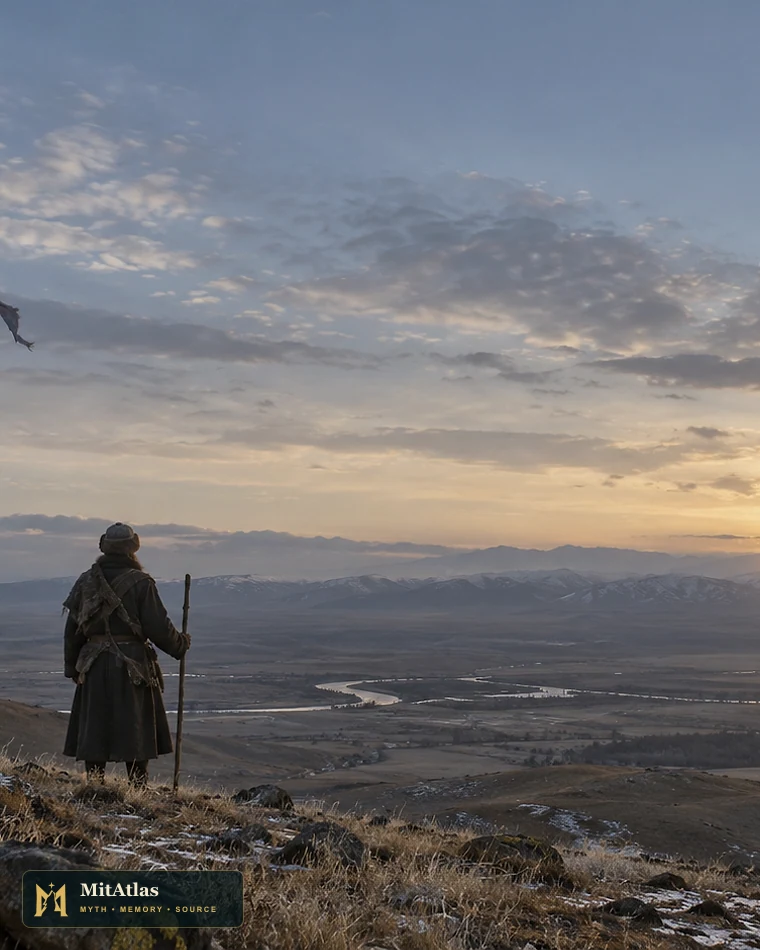
MitAtlas method note: The contemporary event, ancient literary texts, monumental inscriptions and modern ethnographic studies are not treated as equivalent evidence. Dates, genres and communities are identified before comparison. The images are editorial interpretations designed to support reading; they are not presented as documentary reconstructions.