
Short answer
Lokasenna is an Old Norse poem in which Loki quarrels with the gods at Ægir’s feast. Its prose opening describes his expulsion, the verse follows his return and exchange of accusations, and a prose epilogue tells of his capture. Thor’s threats bring the quarrel to an end. Snorri’s Edda gives the capture a different narrative setting.
When Loki walks back into Ægir’s hall, the gods stop talking. He asks for a drink and a place among them. Bragi refuses, but Loki reminds Odin of an old pledge about drinking together. Odin tells Víðarr to make room. It is a small concession with large consequences. Once Loki has a place at the feast, he turns the gathering into a succession of public quarrels. [1]
Lokasenna, often called Loki’s Flyting, is an Old Norse poem framed by prose. Its story has three distinct parts. The opening prose supplies a killing and an expulsion. The verse follows Loki’s return, his accusations, and Thor’s threats. The closing prose takes the story to a waterfall and eventually to Loki’s binding. Reading those parts separately shows what the story actually says about Ægir’s feast and what a reader brings to it from elsewhere in Norse mythology. [1]
What is Lokasenna?

A flyting is a contest of insults. In this poem, a speaker attacks someone’s courage, standing, or conduct, and the target answers or someone else takes up the dispute. Loki is generally the one who keeps the quarrel moving. Each new arrival in the argument gives him a fresh person to address. The result can be funny, cruel, and uneasy within a few lines. Edward Pettit’s edition numbers 65 stanzas and gives the prose opening and ending separately. [1]
The poem is preserved in the Icelandic Codex Regius of the Poetic Edda, a manuscript from the thirteenth century. Pettit locates it at folios 15r–17r and also notes later paper manuscripts. That tells us where the text survives. The age of each story it invokes, the date of composition, and the history of the prose frame are separate questions. Even the speaker directions deserve attention. Some are missing or damaged at the trimmed edge of the manuscript, and the edition records where a label has been supplied. In a poem where an accusation changes meaning depending on who speaks it, that little detail matters. [1]
What happens at Ægir’s feast before Loki speaks?

In the opening prose, Ægir has obtained a huge cauldron and brews ale for the gods. The feast has its own extraordinary rules. Gold provides light, the ale serves itself, and the hall is a place of sanctuary. The prose names Ægir’s two attendants, Fimafengr and Eldir. When the guests praise the attendants, Loki kills Fimafengr. The gods shout, shake their shields, and drive Loki into the woods. Then they go back to their drink. [1]
This opening makes the ensuing silence inside the hall intelligible. The guests know who has come back and what happened the last time he was there. It also changes the stakes of the exchange with Bragi. A quarrel that might have happened outside is now taking place in a hall defined by hospitality and protection. Bragi’s later threat explicitly imagines what he would do outside the hall. Pettit connects this difference in location with the sanctuary described in the opening prose. [1]
Snorri’s Skáldskaparmál also puts shining gold, Fimafengr, and Eldir at a feast hosted by Ægir. Its immediate purpose is to explain a poetic expression for gold through the light in the hall. It mentions Loki’s quarrelling and the killing together, without giving the same sequence of expulsion and return. A shared setting can serve a different purpose in another work. [3]
Why does Loki return to the hall?

The verse begins outside with Loki questioning Eldir about the talk at the feast. Eldir says the people inside are discussing their weapons and their achievements, and that Loki has no friend among them. Loki announces that he means to go in and stir up discord. Eldir warns that if Loki pours out abuse, he can expect an answer. Loki goes in anyway. The poem gives him a stated intention before the guests have a chance to refuse him a seat. [1]
Inside, Loki presents himself as a thirsty traveller and challenges the silent company to seat him or send him away. Bragi takes up that challenge and refuses him a place. Loki then turns to Odin and recalls that they mingled blood and that Odin pledged to drink only if ale was offered to both. The poem presents this as Loki’s appeal to a shared obligation. It supplies no scene of the original pledge. Odin responds by telling Víðarr to stand so that Loki may sit, saying he wants to avoid insults in Ægir’s hall. Víðarr rises and pours for the guest. [1]
The scene contains two answers to the question of why Loki returns. He tells Eldir what he intends to do. Once inside, he gives the company a reason to let him stay. The first answer concerns his aim, the second the obligation he can invoke. The movement from the path to the bench makes the difference visible. [1]
What does the quarrel put under pressure?

Loki’s first toast after he is seated excludes Bragi. Bragi then offers him a horse, a sword, and a ring if he will stop provoking the company. The offer moves from exclusion towards a possible settlement, but Loki answers by attacking Bragi’s courage. Iðunn tries to calm the exchange, and Loki turns on her. The poem repeatedly uses this movement from intervention to exposure. An attempt to control the conversation gives Loki his next target. [1]
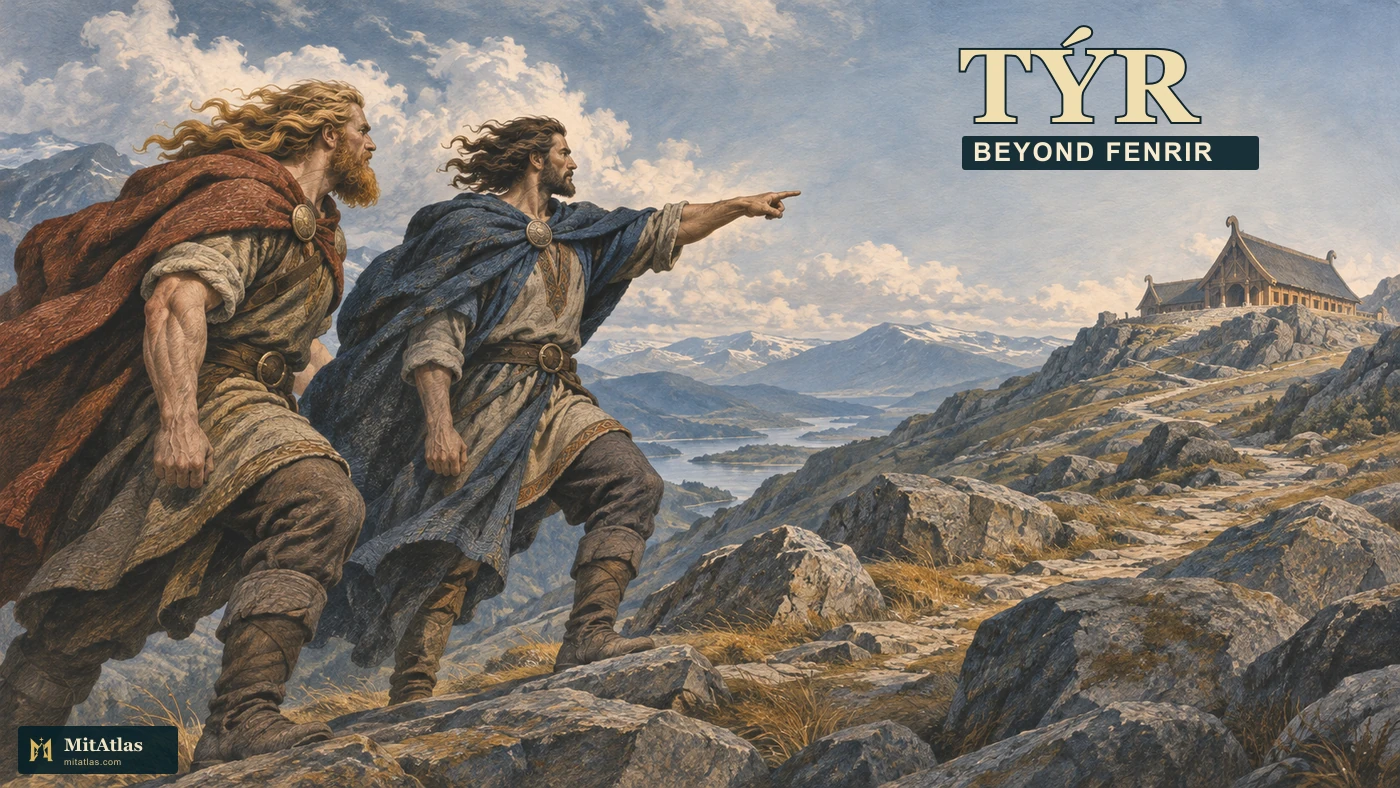
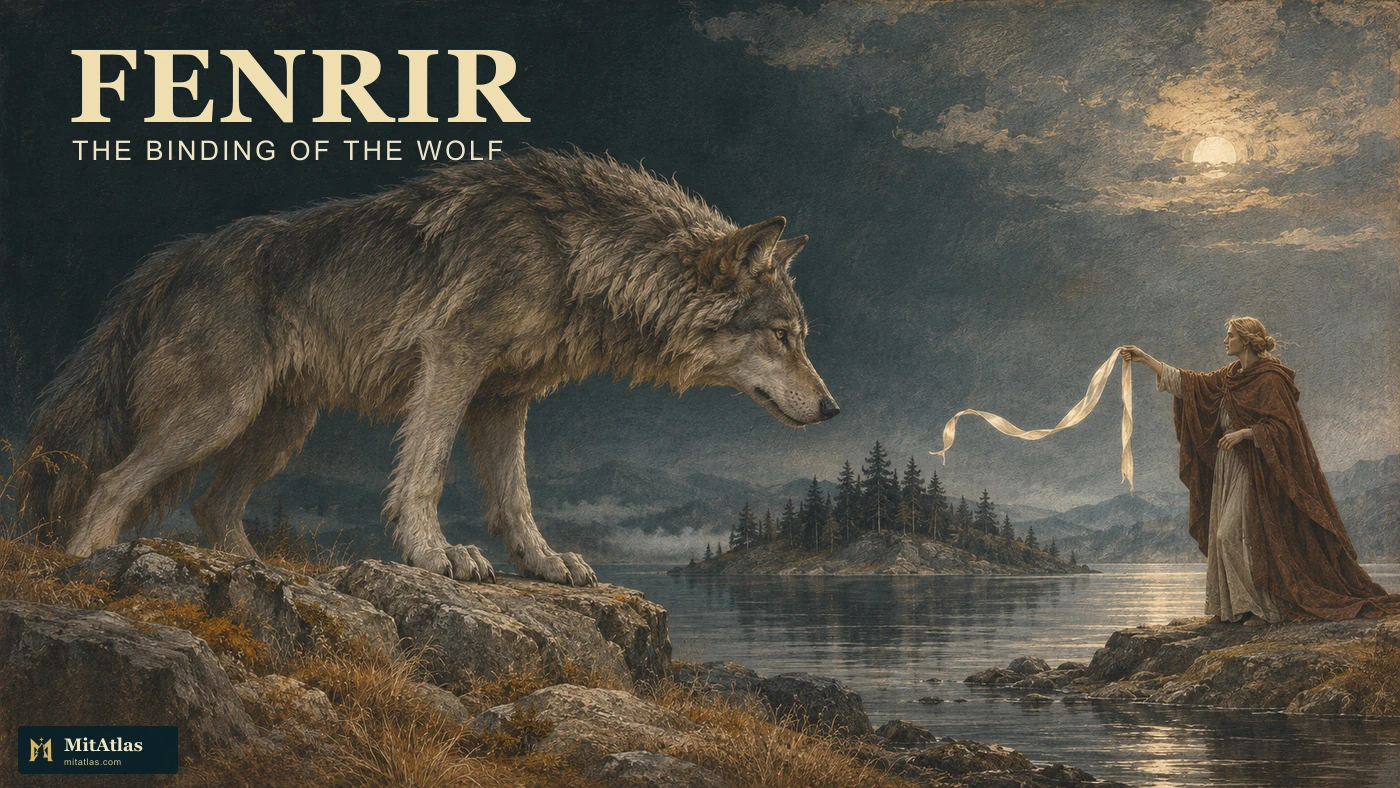
The accusations vary in kind. Loki challenges Odin’s distribution of victories. Later he attacks Týr’s ability to settle disputes, invoking the hand he lost to Fenrir. Týr answers by bringing up what Loki has lost and what the bound wolf must endure. These moments test the characters’ claims to authority in public. Their force depends on the speaker, the moment, and the reply. A hostile remark about what Týr can do carries a different kind of evidence from an editor’s note, a narrator’s description, or a scene in another story. [1] MitAtlas traces those differences further in its accounts of Týr across the Norse sources and the binding of Fenrir.
Sif tries hospitality again late in the quarrel. A prose transition has her offer Loki a drink, and she asks him to recognise her as free of blame. He drinks and then answers with a charge against her. Put beside the earlier toast, this exchange shows how little protection the act of sharing a drink now offers. The scene makes the social meaning of a cup as important as the names of the gods around it. [1]
Why does Loki leave when Thor arrives?

Thor arrives late in the poem and repeatedly threatens to stop Loki’s speech with Mjölnir. Loki answers for several turns, bringing up episodes in which the formidable traveller looked powerless, such as taking shelter in a giant’s glove. Eventually he says he will leave for Thor alone, because he believes Thor will act on the threat. That is Loki’s stated reason. The poem gives us the exchange of words up to that point. It leaves any actual blow outside the story it tells. [1]
Loki’s final stanza addresses Ægir. He tells the host he will give no more feasts and calls down fire on his possessions. It is a curse spoken by a departing guest. The next part of the text moves to Loki’s hiding place, without describing the hall burning. The ending returns attention to the host whose feast made the contest possible. [1]
How does the prose ending differ from Snorri’s account?

The prose after stanza 65 begins with a change of place and form. Loki hides as a salmon at Fránangrsfors, where the gods catch him. The epilogue then moves quickly to his binding and to Sigyn, his wife, catching the drops from a serpent in a basin. When she empties it, drops reach Loki, and his reaction explains earthquakes within the story. This epilogue joins the aftermath to the quarrel by sequence, but it leaves the mechanics of the capture untold. [1]
In Gylfaginning, Gangleri asks whether Loki was punished in connection with Baldr’s death and Baldr’s failed return from Hel. The answer expands the pursuit. Loki escapes to a mountain refuge, takes salmon form at the waterfall, and throws a net he has made into the fire when the gods approach. Kvasir reads the pattern left in the ashes. The gods make a net and try repeatedly to catch the fish. In the end, Thor grips him near the tail. The shape of the salmon is explained through that grip. The role of Loki’s sons in the punishment is given differently from Pettit’s prose epilogue, so the names should be checked within each source rather than transferred between them. [1] [2]
The clearest way to hold the accounts together is to keep their questions distinct. At the feast, Loki makes a claim to Frigg about Baldr’s absence, and near the close he tells Thor why he will go. The epilogue proceeds to the waterfall. Snorri’s dialogue supplies an explicit question about retribution for what happened to Baldr. Those are three different kinds of statement. Reading them together shows where a later retelling gets its details and where it has joined material the sources present in different ways. For another example of reading Norse accounts side by side, see MitAtlas’s guide to Yggdrasil across the Eddas. [1] [2]