
Short answer
Týr is the Norse god who pledges his hand to Fenrir. In the Eddic poems he guides Thor to Hymir’s cauldron and answers Loki at a feast. Snorri names Odin as his father in a handbook of poetic diction and pairs him with the hound Garmr at Ragnarök. The justice label draws on a separate scholarly comparison.
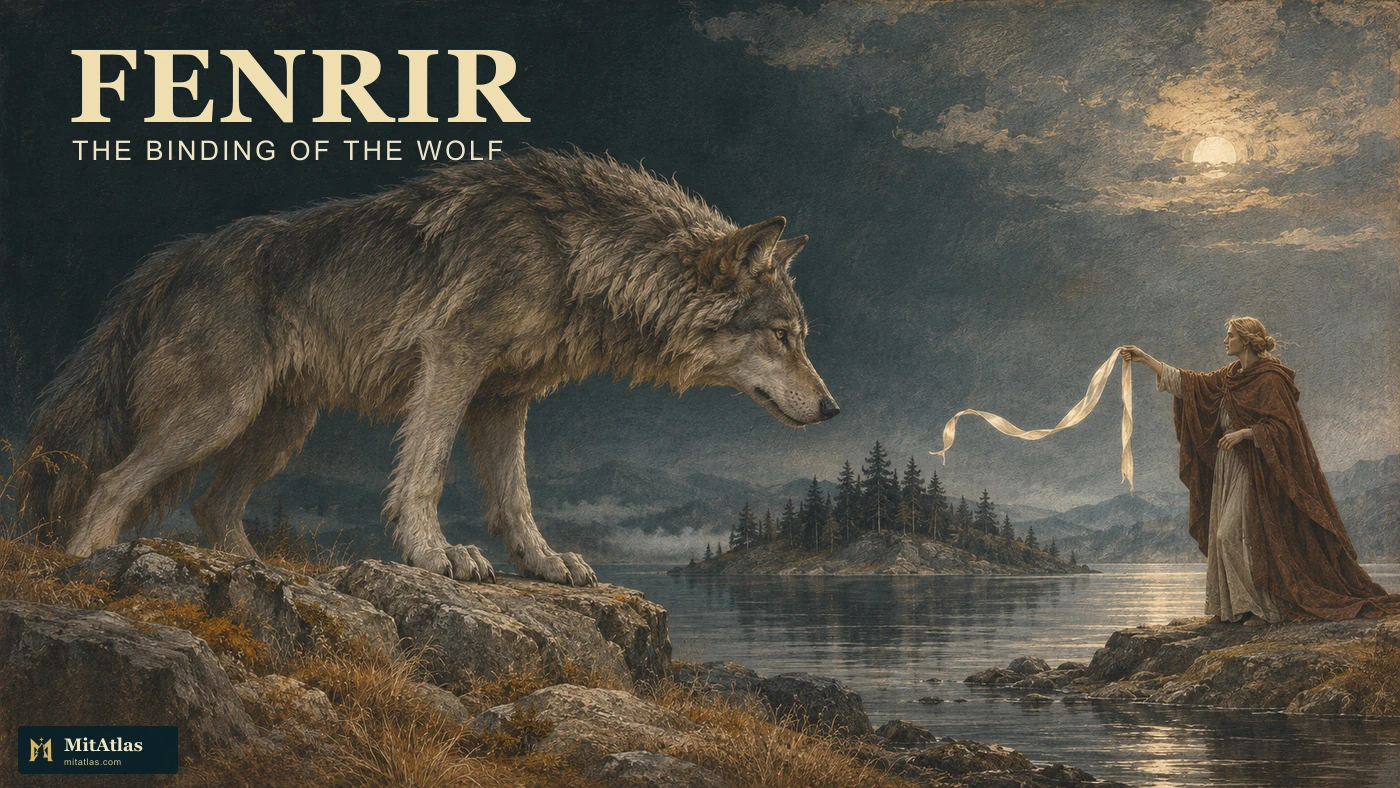
Týr is the Norse god who puts his hand at stake when the gods bind Fenrir. That episode explains his most familiar attribute, but it is only one of the places where he appears. In an Eddic poem he knows where to find the cauldron the gods need. At a feast he answers Loki in his own voice. In Snorri Sturluson’s account of Ragnarök he faces the hound Garmr, while Odin faces Fenrir. Even the identity of his father changes with the text. [1] [2] [3] [5]
The sources offer several ways to get to know him. A storyteller names qualities, a poem gives him a task, and a guide to poetic diction lists ways of referring to him. Each can tell us something different about Týr. Read together, they also show why a single modern label rarely does the work of all three.
How does Snorri introduce Týr?

In chapter 25 of Gylfaginning, the questioner Gangleri hears about Týr from the figure called Hár. The description starts with daring and influence over victory in battle. Hár gives examples of sayings that use Týr’s name to describe exceptional courage and wisdom. Only then does he bring in the hand pledged to Fenrir. The order matters. The pledge illustrates a quality the storyteller has already named. [1]
Hár closes by saying that Týr is one-handed and is not called a reconciler of people. The two statements sit close together. The passage can establish that Snorri’s narrator associates Týr with boldness and battle victory. The reader has to look elsewhere for evidence of a standing role in the settlement of disputes. The chapter’s own final line complicates that description. For the complete episode and the gods’ terms, see the account of Fenrir and Gleipnir. [1]
Gylfaginning presents this material as a dialogue in a medieval Icelandic work. Its descriptions can preserve older material while also reflecting the writer’s choices about what to put together and how to explain it. Hár’s list is a good starting point for the literary figure. It gives us less purchase on how a particular person in an earlier century might have addressed the god.
Why does Týr seek Hymir’s cauldron with Thor?

Hymiskviða, the Lay of Hymir, begins with a practical problem of extravagant proportions. Ægir needs a cauldron large enough to brew for the gods. Týr knows where one can be found. He speaks up and says that Hymir possesses a vessel deep enough for the task. Týr and Thor set out together for Hymir’s hall. Their journey gives Týr something he rarely gets in short accounts of the myths: a role in setting the story in motion. [2]
Late in the poem the challenge turns on whether anyone can move the thing. Týr tries twice and the cauldron stays put. Thor lifts it and carries it away. The two acts belong to different kinds of competence. Týr has the knowledge that makes the journey possible, and Thor has the strength that gets the cauldron out of the hall. Reading only the feat of lifting makes it easy to overlook who first made the expedition possible. [2]
The poem also lets us see Týr in a household. A woman identified as his mother shelters the visitors, and she later gives Thor the advice he needs during the contest with the cup. For a reader interested in Týr, the visit brings relationships into view that would never appear in a list of divine titles. The poem can be read as a story about what several people contribute to an undertaking, even though Thor performs its most conspicuous feat. [2]
Who is Týr’s father in the surviving sources?

In Hymiskviða the answer is Hymir. Týr calls him his father while explaining who owns the cauldron. The reference belongs to the scene: the speaker knows the household and tells the others what they can find there. In Skáldskaparmál, a different part of Snorri’s Edda, Odin is given as Týr’s father. The relationship appears among the expressions a poet can use to name Týr indirectly. [2] [5]
Those passages perform different jobs. One is dialogue in a story of a visit to Hymir’s hall. The other is an instruction in poetic diction, alongside references to the god’s missing hand, his feeding of the wolf and his association with battle. Putting both in a family tree without their source labels makes them look like pieces of one biography. The texts themselves provide no explanation that joins the two relationships. [5]
The most useful answer is therefore specific enough that someone else can check it. Name Hymir when describing the poem, and name Odin when describing the handbook. The same way of reading helps with accounts of Yggdrasil, where the details that matter also depend on which passage is being read.
What can Loki’s taunts tell us about Týr?

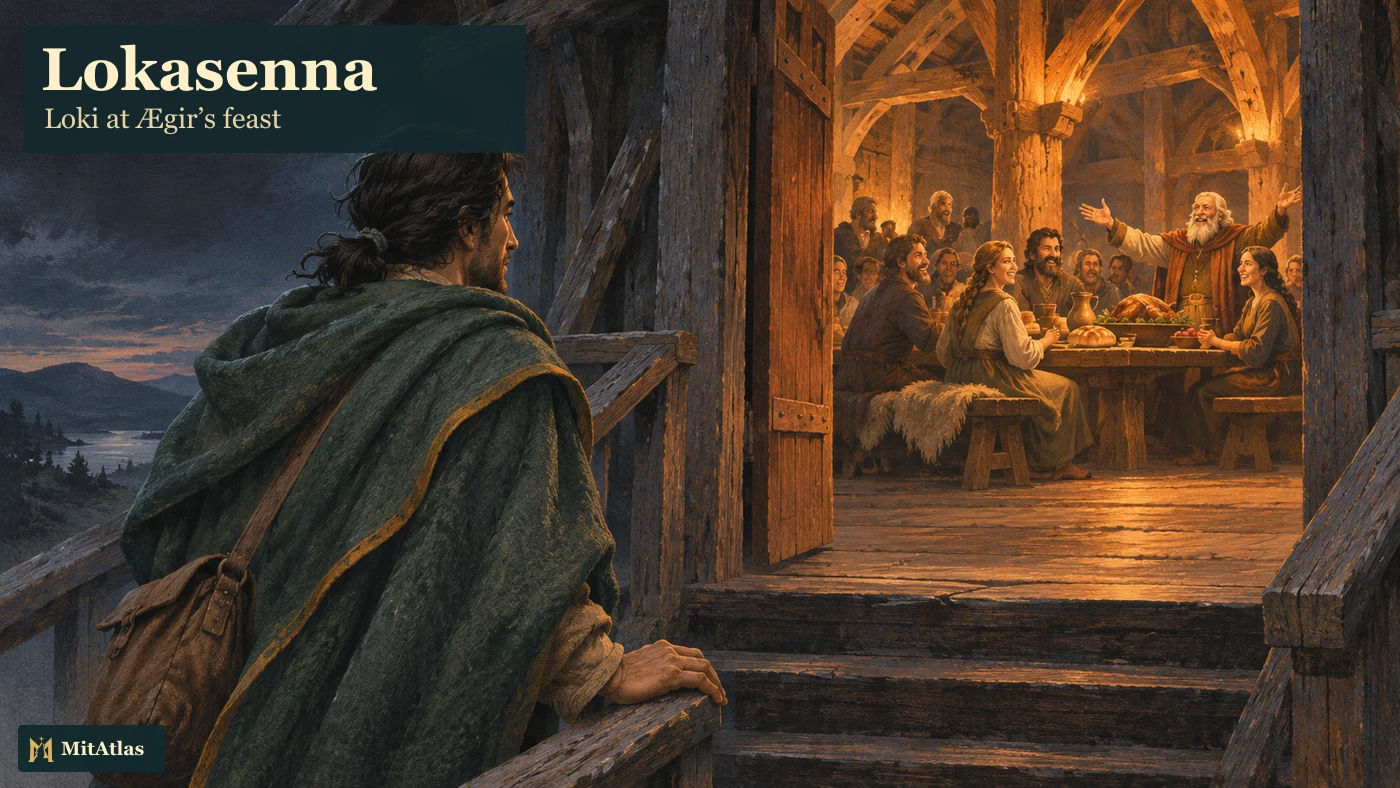
In Lokasenna, the gods’ gathering at Ægir’s turns into a contest of insults. Týr first speaks in praise of Freyr. Loki answers that Týr could never settle matters fairly between two parties and brings up the hand Fenrir took from him. Týr does not argue about his skill as a mediator. He turns the remark back on Loki by pairing his own loss with Loki’s separation from the bound wolf. The wolf itself, he adds, must endure the wait. [3]
The shift in perspective is small and revealing. In Snorri’s introduction, the hand shows Týr’s daring. At the feast, Týr uses the same loss to name what the binding has cost more than one participant. The exchange works because the listeners know what Loki is talking about. It gives the poet no reason to retell the whole incident or explain exactly how the audience is supposed to judge it. [1] [3]
Loki continues with another attack on Týr’s household and a claim about compensation. The scene gives us a speaker trying to wound another speaker with words. It does not supply independent witnesses to each accusation. The charge about peacemaking matters because we can compare it with Snorri’s wording. Its weight still comes from a poem organized around hostile, strategic speech. [3]
Who faces Týr at Ragnarök?

Chapter 51 of Gylfaginning assigns opponents across the field of Ragnarök. Odin goes against Fenrir. Thor faces the Midgard Serpent. The hound Garmr breaks loose from his restraint before Gnipahellir and encounters Týr. Týr and Garmr kill one another. In Snorri’s sequence the two canine figures belong to separate pairings. There is no second fight between Týr and Fenrir here. [1]
For readers who have met Garmr in Vǫluspá, there is room for a further question. The poem’s recurring image of the hound and its failing restraint does not set out Snorri’s full list of opponents. In his glossary, Faulkes notes the possibility of an identification with Fenrir in the poem while observing that Snorri treats them as distinct. The distinction belongs to the account we can read directly. The relationship between the figures across traditions remains a question of interpretation. [1] [6]
Where does the familiar god-of-justice label come from?

There is clear literary evidence for Týr’s association with battle. Hár describes his influence over victory and Skáldskaparmál includes a battle-related name. In stanza 6 of Sigrdrífumál, Sigrdrífa tells Sigurðr about victory-runes and calls for Týr’s name to be spoken twice. That stanza gives a particular use of the name within a poem. It cannot establish how widespread the practice was. [1] [4] [5]
The legal association often draws on a different kind of evidence. A dedicatory inscription from Housesteads on Hadrian’s Wall, catalogued as RIB 1593, names Mars Thincsus alongside other recipients of a dedication. In Nine Norse Studies, Gabriel Turville-Petre discusses a comparison between Týr and Mars Thincsus and relates the epithet to the assembly, or thing. That is a comparative argument linking material from different places and periods. The inscription gives us the wording of a Roman-period dedication in Britain. The Eddic passages give us a character in medieval Icelandic texts. The bridge between them is an interpretation and deserves to be named as such. [7] [8]
| Evidence | What it supports |
|---|---|
| Gylfaginning 25 | Hár associates Týr with courage and victory, and closes by withholding the role of reconciler. |
| Lokasenna 38–39 | Loki attacks Týr’s ability to make peace. Týr’s reply shifts the subject to what each of them has lost. |
| Housesteads inscription, RIB 1593 | The dedication names Mars Thincsus. It gives us no direct statement about the Eddic Týr. |
| Turville-Petre’s comparison | The assembly connection is an argument made by comparing distinct bodies of evidence. |
A more precise description of Týr begins with what the passages repeatedly let him do. He acts boldly, contributes knowledge to a shared enterprise, answers a public insult and faces an opponent at Ragnarök. The justice label raises a question worth investigating. Reading Týr through the actual exchanges, journeys and descriptions gives us a fuller answer than the label can provide on its own.